Assessment Guide
Page 1
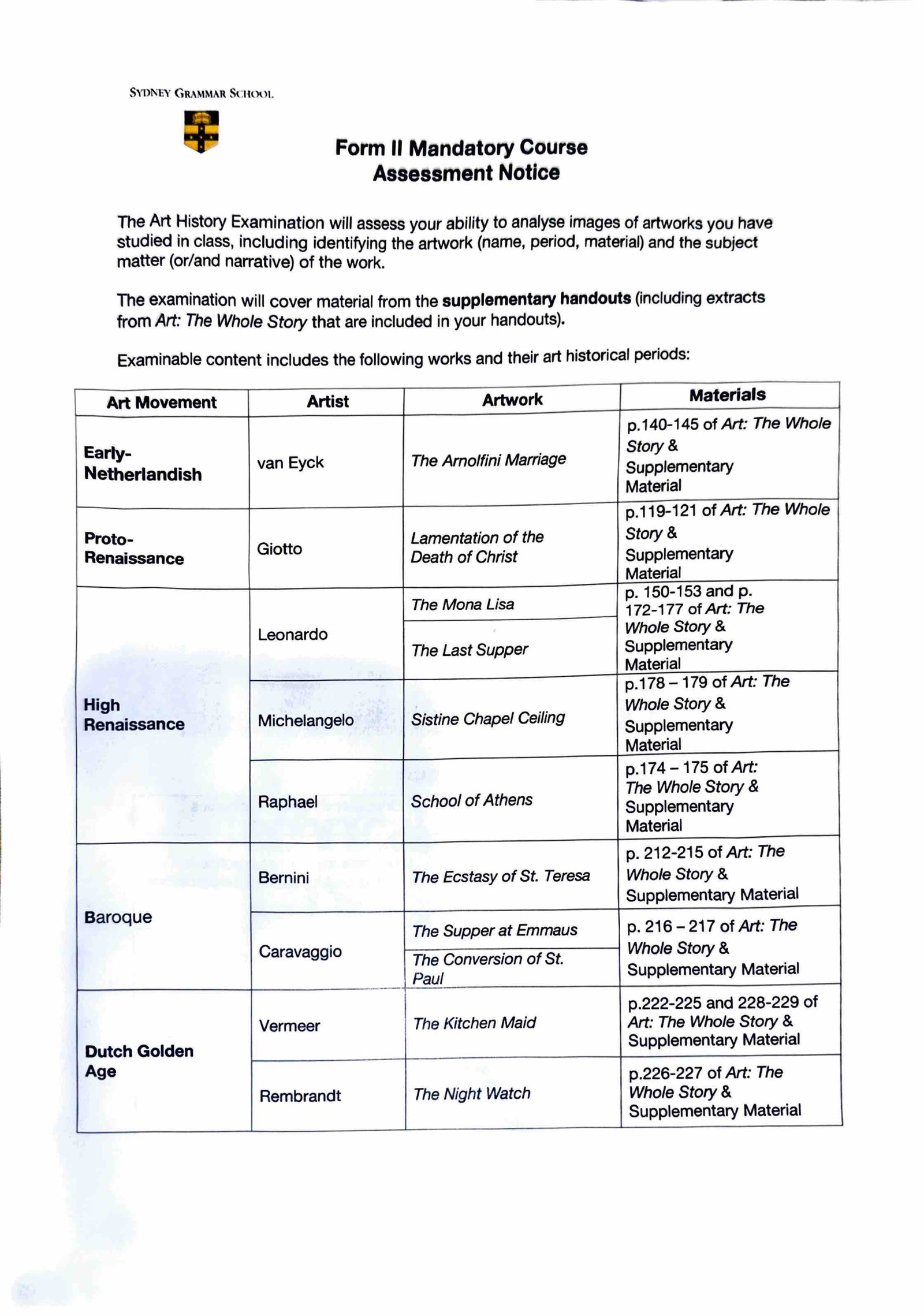
Form II Mandatory Course: Assessment Notice Annual Examinations 2026
Task 1: Assessment of your studio practical work, Acrylic Painting (Weighting 30%)
Your completed acrylic study of Roy de Maistre's 'the boat sheds, in violet red key' 1919 will be moderated and assessed on your ability to demonstrate skills in using acrylic paint to mix colour to create form and match tonal values, plus your accuracy in applying paint.
Task 2: Art History Examination (Weighting 50%)
- Date: TBD, 28 October to 4 November 2026
- Time: 60 minutes
Structure of Paper
- Section 1: Multiple-choice questions (20 marks)
- Section 2: Short response questions (20 marks)
- Section 3: Long response questions (5 marks each)
Task 3: Drawing Examination (Weighting 20%)
- Date: TBD, 28 October to 4 November 2026
- Time: 60 minutes
This Drawing Examination will assess your observational skills, use of graphite pencil and the construction and shading of objects in a common still life arrangement which will be provided.
NESA Objectives
| Artmaking | Critical and Historical Studies |
|---|---|
| 4.1 uses a range of strategies to explore different artmaking conventions and procedures to make artworks | 4.7 explores aspects of practice in critical and historical interpretations of art |
| 4.3 makes artworks that involve some understanding of the frames | 4.8 explores the function of and relationships between the artist – artwork – world – audience |
| 4.4 recognises and uses aspects of the world as a source of ideas, concepts and subject matter in the visual arts | 4.9 begins to acknowledge that art can be interpreted from different points of view |
| 4.6 selects different materials and techniques to make artworks | 4.10 recognises that art criticism and art history construct meanings |
Page 2
Form II Mandatory Course: Assessment Notice
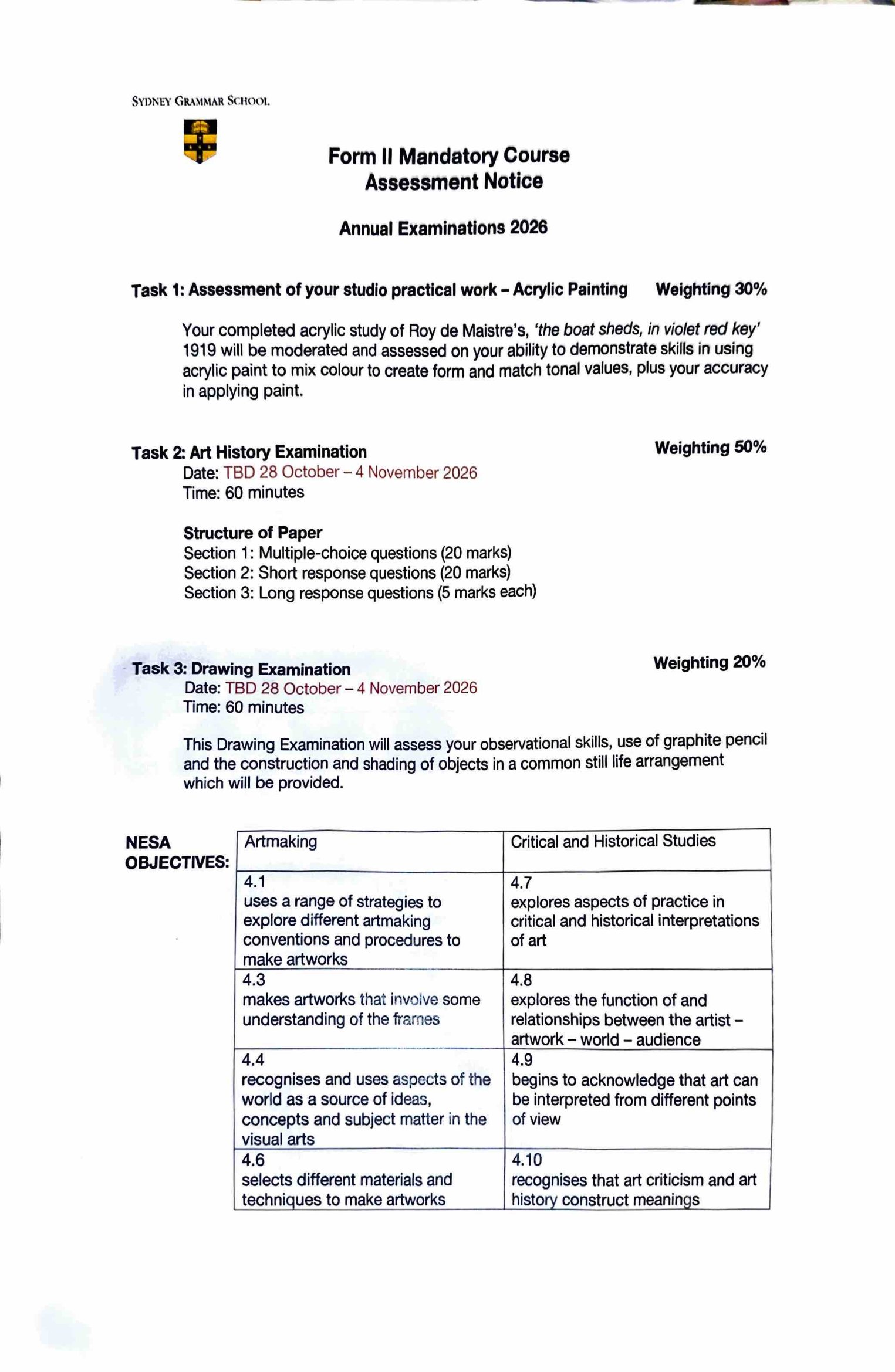
The Art History Examination will assess your ability to analyse images of artworks you have studied in class, including identifying the artwork (name, period, material) and the subject matter (or/and narrative) of the work.
The examination will cover material from the supplementary handouts (including extracts from Art: The Whole Story that are included in your handouts).
Examinable content includes the following works and their art historical periods:
| Art Movement | Artist | Artwork | Materials |
|---|---|---|---|
| Early Netherlandish | van Eyck | The Arnolfini Marriage | p.140-145 of Art: The Whole Story & Supplementary Material |
| Proto-Renaissance | Giotto | Lamentation of the Death of Christ | p.119-121 of Art: The Whole Story & Supplementary Material |
| High Renaissance | Leonardo | The Mona Lisa | p.150-153 and p.172-177 of Art: The Whole Story & Supplementary Material |
| High Renaissance | Leonardo | The Last Supper | p.150-153 and p.172-177 of Art: The Whole Story & Supplementary Material |
| High Renaissance | Michelangelo | Sistine Chapel Ceiling | p.178-179 of Art: The Whole Story & Supplementary Material |
| High Renaissance | Raphael | School of Athens | p.174-175 of Art: The Whole Story & Supplementary Material |
| Baroque | Bernini | The Ecstasy of St. Teresa | p.212-215 of Art: The Whole Story & Supplementary Material |
| Baroque | Caravaggio | The Supper at Emmaus | p.216-217 of Art: The Whole Story & Supplementary Material |
| Baroque | Caravaggio | The Conversion of St. Paul | p.216-217 of Art: The Whole Story & Supplementary Material |
| Dutch Golden Age | Vermeer | The Kitchen Maid | p.222-225 and 228-229 of Art: The Whole Story & Supplementary Material |
| Dutch Golden Age | Rembrandt | The Night Watch | p.226-227 of Art: The Whole Story & Supplementary Material |