Cycles 15-16: High Renaissance, Leonardo da Vinci
Page 1
Form II Art History Supplementary Material
Cycle 15 & 16 – High Renaissance – Leonardo
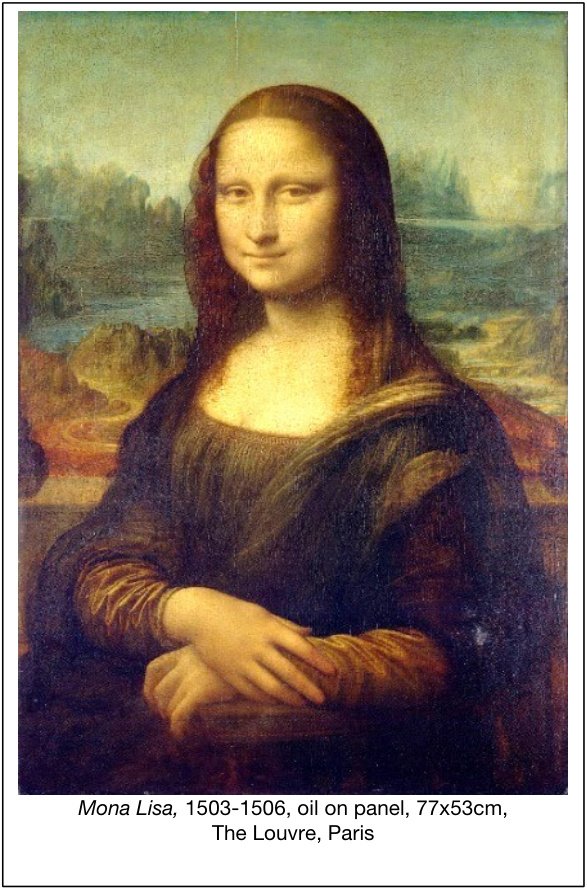
Mona Lisa, 1503-1506, oil on panel, 77x53cm,
The Louvre, Paris
Name:_______________________________________________________
House / Tutor: _______________________ Master: _______________
Page 2
Form II Art History Supplementary Material
Key Points
-
Renaissance
-
Means rebirth of classical culture – artists were inspired by Greek and Roman ideas. Art focused on religion, humans and nature
-
Developed in Florence
-
-
High-Renaissance
- This period is the peak of artistic achievement, ranging from 1490s to 1527. Most artworks were commissioned by the Church of Popes
-
Humanism
- Focused on human potential and learning. Artists also studied science, anatomy and nature
-
Mannerism
- This used elongated figures and artificial poses. Was less natural and more stylised
-
Vasari
-
Renaissance art developed in three main stages;
-
Early stage – beginnings
-
Middle stage – development
-
Final stage – peak
-
-
Vocabulary:
-
Humanism
-
- Mannerism
1
Page 3
Form II Art History Supplementary Material
The Renaissance
Read pages 150-151 , The Early Renaissance, and answer the following questions.
-
What does the word ‘Renaissance’ mean?
-
Why was it used to describe this period?
- What continued to inspire the subject matter of Renaissance artists, and what other subject matter did they begin to explore?
- In what Italian city did the art of the Early Renaissance flourish?
- Who were the key artists working in this city? What medium did each specialise in?
i__________________________________________________________ ii__________________________________________________________ iii__________________________________________________________
2
Page 4
Form II Art History Supplementary Material
Read pages 172 – 175 in your textbook and answer the following questions.
- Which two cities were the most important for artists of the High Renaissance ?
i________________________________________________________
ii_________________________________________________________
-
Who was responsible for commissioning the majority of works during the High Renaissance?
-
Name THREE prominent artists of the High Renaissance.
| i____________________________________________________________________________________ ii__ |
|---|
iii_ ___________________________________________________________________________________ |
3
Page 5
Form II Art History Supplementary Material
Cultural Frame – World
Key Points
-
Many art historians consider the High Renaissance to be largely dominated by three artists: Michelangelo, Raphael, and Leonardo da Vinci.
-
Mannerism, which emerged in the latter years of the Italian High Renaissance, is notable for its intellectual sophistication and its artificial (as opposed to naturalistic) qualities, such as elongated proportions, stylised poses, and lack of clear perspective. Some historians regard Mannerism as a degeneration of High Renaissance classicism, or even as an interlude between High Renaissance and Baroque, in which case the dates are usually from c. 1520 to 1600, and it is considered a positive style, complete in and of itself.
Key Terms
-
High Renaissance : The period in art history denoting the apogee (which means the highest point in the development of something) of the visual arts in the Italian Renaissance.
-
The High Renaissance period is traditionally acknowledged as beginning in the 1490s, coinciding with Leonardo’s fresco of The Last Supper (painted in Milan) and the death of Lorenzo de’ Medici in Florence. It is generally cited as ending in 1527, with the ‘Sack of Rome’ by the troops of King Charles V of Spain and the Holy Roman Emperor.
-
Mannerism : A style of art developed at the end of the High Renaissance, is characterised by the deliberate distortion and exaggeration of perspective, especially the elongation of figures.
-
The term ‘High Renaissance’ denotes a period of artistic production that is viewed by art historians as the height, or the culmination, of the Renaissance period.
Giorgio Vasari's Three Phases of the Renaissance
In 1550, Vasari retrospectively viewed the development of the rebirth of classical art as an evolutionary process in three phases, each corresponding to a phase in human life.
The first phase could be compared to childhood, and was introduced by Cimabue and Giotto in painting, Arnolfo di Cambio in architecture, and Pisani in sculpture.
The second phase, corresponding to adolescence, was represented by Masaccio, Brunelleschi, and Donatello.
The third phase, that of adulthood, was initiated by Leonardo da Vinci and brought to full fruition by Raphael, reaching its pinnacle with Michelangelo, the great uomo universale, meaning ‘universal man’.

Giorgio Vasari (born July 30, 1511, Arezzo [Italy]—died June 27, 1574, Florence), Italian painter, architect, and writer who is best known for his important biographies of Italian Renaissance artists
4
Page 6
Form II Art History Supplementary Material
Leonardo da Vinci (1452-1519)
- Leonardo da Vinci was a painter, engineer, architect, scientist, and inventor. His curious mind and inductive reasoning (*based on observation and experience) exemplified the humanist sentiment of the High Renaissance.
Humanism: The defining intellectual movement of the Renaissance, humanism proposed a rebirth of ancient Greek and Roman cultures, including poetry, rhetoric, history, moral philosophy, and grammar. The secular leanings of humanism contrasted with the more rigid theological teachings of the Middle Ages.
-
*We can, perhaps, label Leonardo da Vinci as an early empiricist, more than a hundred years before Locke et al. He held that ‘wisdom was the daughter of experience’, and his many notebooks are an incredible testimony to his use of experience and observations rather than a priori intuitions. The word ‘a priori’ is Latin and means basing understanding on ‘what comes first’, or ‘assumptions'.
-
At a young age, Leonardo was apprenticed to the workshop of Andrea del Verrocchio, a sculptor, painter, and goldsmith. Here, Leonardo studied painting, sculpture, and architecture and gained a background in the natural sciences, including botany and optics.
-
The Baptism typifies the Renaissance practice of collaborative painting within a single artist’s workshop. An apprentice might complete the background of a painting, while the master artist would paint more technically challenging areas, such as facial features.
-
Do note there is a wide variance in the quality of work in this painting – the palm tree to the left and the outstretched hands of God releasing the dove (symbolising the Holy Spirit) have been painted in an awkward, if not clumsy, manner. However, the kneeling angel to the left has been attributed to Leonardo – her delicate features have been rendered softly and carefully.
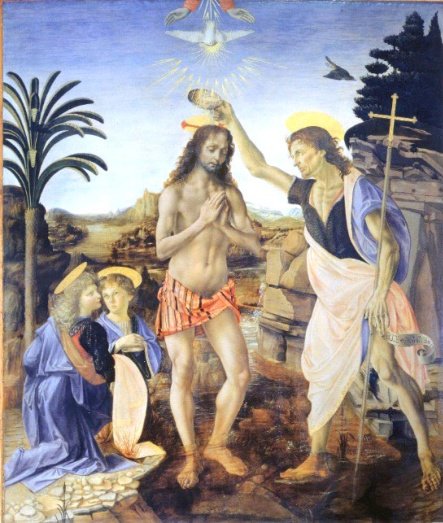
Andrea del Verrocchio and his workshop (including Leonardo) The Baptism of Christ, 1472-1475, oil on panel
5
Page 7
Form II Art History Supplementary Material
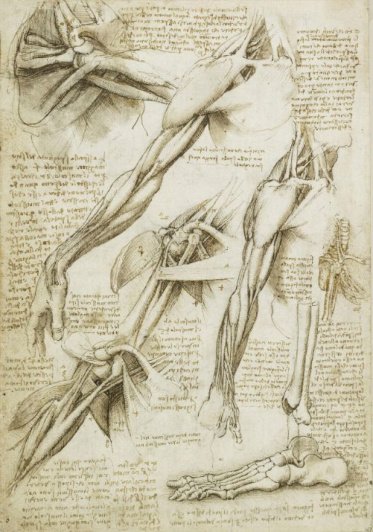
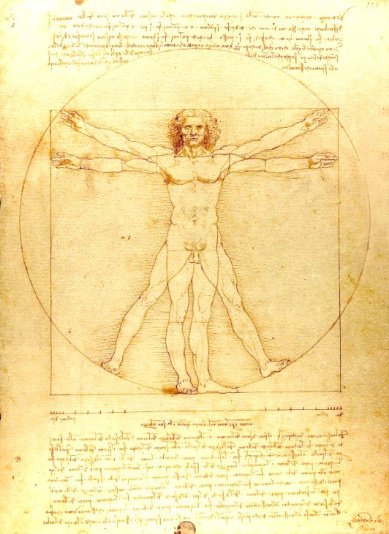
Leonardo’s anatomical drawings (left) and The Vitruvian Man (right)
-
Leonardo’s anatomical drawings represented a new spirit of intellectual enquiry that emerged during the High Renaissance. Anatomical dissections enabled a much deeper understanding of the workings of the human body. Leonardo’s drawings reveal the observational precision of a scientific mind.
-
The Vitruvian Man demonstrates the ideal proportions of the human body as set out by the Roman architect Vitruvius in his treatise De Architectura (which translates as On Architecture ), and his claims that such a body could fit perfectly into both a circle and a square. Leonardo did, however, alter Vitruvius’ original proportions somewhat.
-
Vitruvian means pertaining to Vitruvius, an Ancient Roman architect.
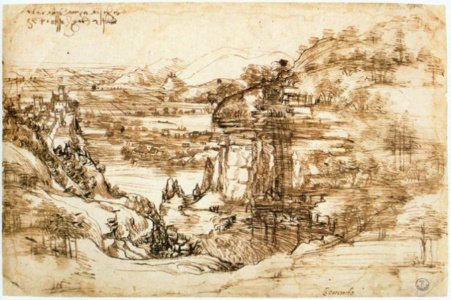
Landscape of the Arno Valley (1473)
The earliest surviving work by Leonardo, and one of the earliest surviving landscape drawings. This drawing demonstrates Leonardo’s keen interest in the natural world and conveys a convincing sense of depth.
6
Page 8
Form II Art History Supplementary Material
-
The development of linear perspective by the Florentine sculptor Filippo Brunelleschi signified a dramatic shift in artistic representation in the Renaissance, away from the stylised, flattened paintings of the medieval period.
-
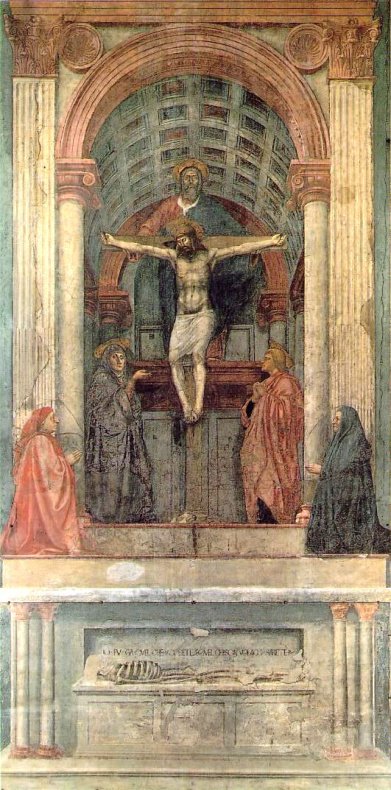
Masaccio’s fresco Holy Trinity (c. 1427, pictured right) is one of the earliest artworks to make use of Brunelleschi’s findings. The lines created by the panels in the barrel vault converge at a single vanishing point, giving the illusion of threedimensional space.
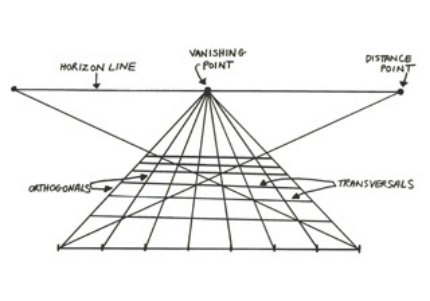
Linear perspective : The depiction of threedimensional space on a two-dimensional surface such that all parallel lines (called orthogonal lines) converge at a vanishing point on the horizon line.
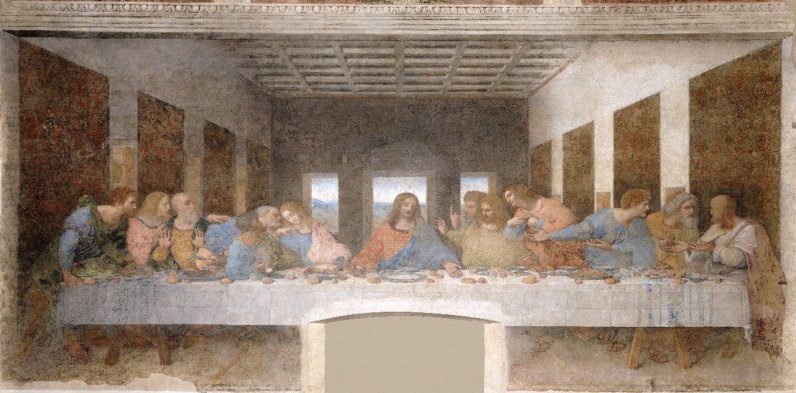
- Leonardo made effective use of Brunelleschi’s findings in his fresco The Last Supper (c.1490s, see below), which depicts the moment that Jesus Christ announces his impending betrayal to his disciples.
7
Page 9
Form II Art History Supplementary Material
Name: ________________________________________________________________________________ Tutor: _____________
Cycle 16 Leonardo Homework
Total: 10 marks
Refer to the textbook pp176-177 and the definitions below and answer the following questions on the Mona Lisa.
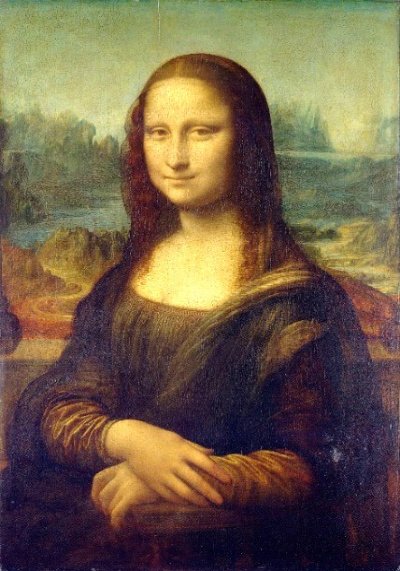
Mona Lisa, 1503-1506, oil on panel, 77 x 53cm, The Louvre, Paris
Sfumato : From the Italian fumo, meaning “smoke”. This painting technique involves subtle, almost imperceptible transitions of colour and tone to create soft ‘smokelike’ edges. Sfumato effects are aided by the slow drying times of oil paints, which afford the artist more time to blend colours together.
Aerial perspective : Also known as atmospheric perspective, this is a manner of achieving a sense of depth whereby objects further away are affected by the interference of the atmosphere. They will appear hazy (with softer edges), lose contrast, and take on a blue-grey tinge.

- Who is the subject of this portrait?
/1
/2
- Describe the composition of this painting: /2 _________________________________________________________________________________ _________________________________________________________________________________ _________________________________________________________________________________ _________________________________________________________________________________
8
Page 10
Form II Art History Supplementary Material
- How has Leonardo created a sense of depth and space? /2
- Describe Leonardo’s use of colour and tone. /2
Refer to the video (link below) and answer the following question on The Last Supper. Video: https://www.khanacademy.org/humanities/ap-art-history/early-europe-and-colonial- americas/renaissance-art-europe-ap/v/leonardo-da-vinci-last-supper-1495-98
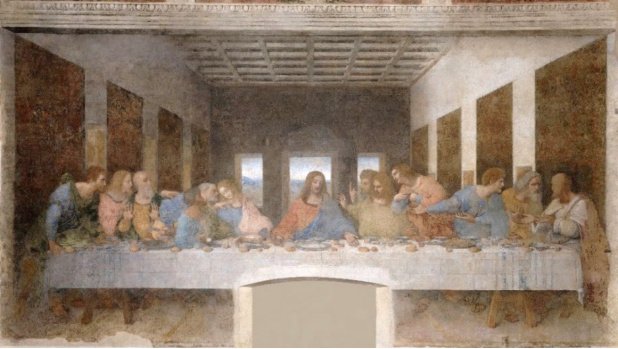
Analyse the composition of The Last Supper. Despite the psychological tension of the subject matter, Leonardo has created a balanced and harmonious image. How has he achieved this? /3
9
Page 11
Form II Art History Supplementary Material
10