Cycles 22-23: Dutch Golden Age, Vermeer
Page 1
Form II Art History Supplementary Material
Cycle 22 – Dutch Golden Age
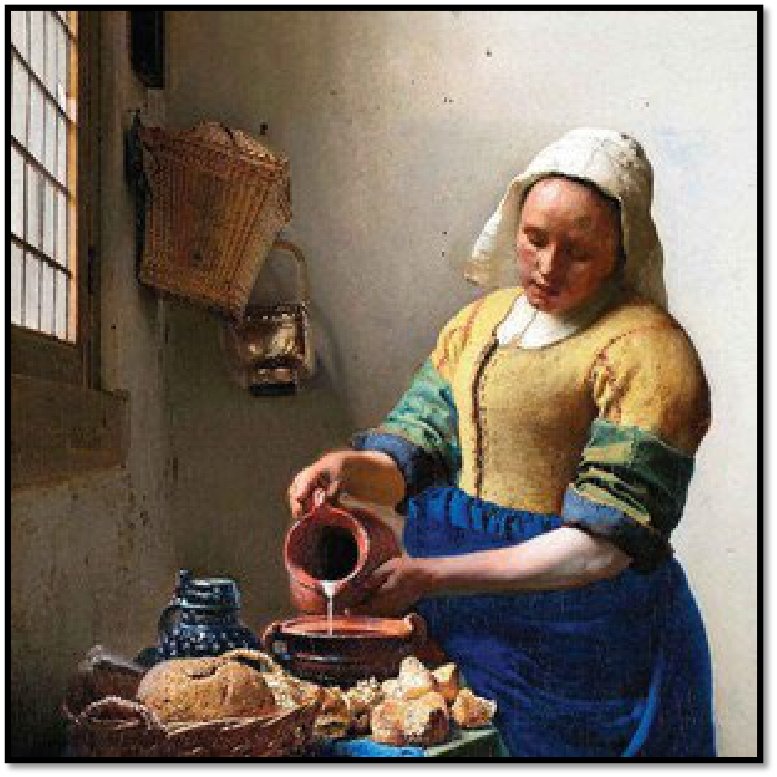
Johannes Vermeer, The Kitchen Maid , oil on canvas, 1658, 45.5 x 41c m
Name: ____________________________________ Class: _______________
House / Tutor: ___________________________ Master: _______________
Page 2
Form II Art History Supplementary Material
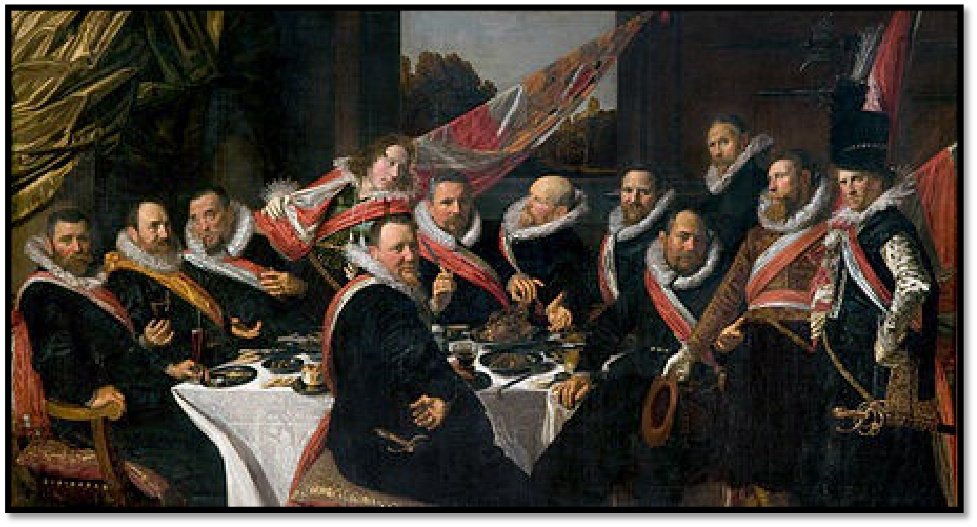
Frans Hals, The Banquet of the Officers of the St George Militia Company , oil on canvas, 1616, 175 x 324cm
Dutch Golden Age
The Dutch Golden Age is one of the greatest examples of independence and cultural pride during the 17th century. Although the Reformation had arrived in the Low Countries (Netherlands) around 1530, the Dutch remained ruled over by Catholic Spain. King Phillip II (r.1556-98) was the son of Charles V, the Holy Roman Emperor (r.1519-56) and he continued his father’s anti-protestant policies (including the Inquisition which sought to identify and destroy ‘heretics’).
* Inquisitors would arrive in a town and announce their presence, giving citizens a chance to admit to heresy. Those who confessed received a punishment ranging from a pilgrimage to a whipping.
Those accused of heresy were forced to testify. If the heretic did not confess, torture and execution were inescapable. Heretics weren’t allowed to face accusers, received no counsel and were often victims of false accusations.
Religious persecution, coupled with high taxes, led to the Eighty Years War, which ended only with the signing of the Peace of Westphalia (1648). This treaty ended the war and created an independent Protestant Dutch Republic. The Dutch Republic then experienced a surge in economic and cultural prominence, and its art began to take an entirely new direction. An increase in trade boosted commerce and led to the rise of a large middle and merchant class, who commissioned artists to make work that responded to the flourishing celebration of Dutch life and identity. Beginning in 1600 and ending in 1672, the Dutch Golden Age represented a celebration of artists focussing on everyday scenes of ordinary life (known as genre painting ), which was indicative of a thriving creative period.
The subjects of still life, portraiture, landscape, and domestic interiors gained popularity at the expense of more traditional images such as devotional scenes and biblical and historical narratives.
1
Page 3
Form II Art History Supplementary Material
Frans Hals’s A Banquet of the Officers of the St George Militia Company is characteristic of the Dutch Golden Age due to its high degree of realism. Do note how the asymmetrical arrangement of figures breaks from the traditional conventions of the time. Art developed an emphasis on secular subjects, depicted not with Catholic grandeur, but instead showing ordinary, everyday life with a realistic treatment of subject matter.
The term ‘ genre painting’ is used to denote scenes in alehouses, kitchens, courtyards, and brothels, for example, in which the daily lives of ordinary people are represented.
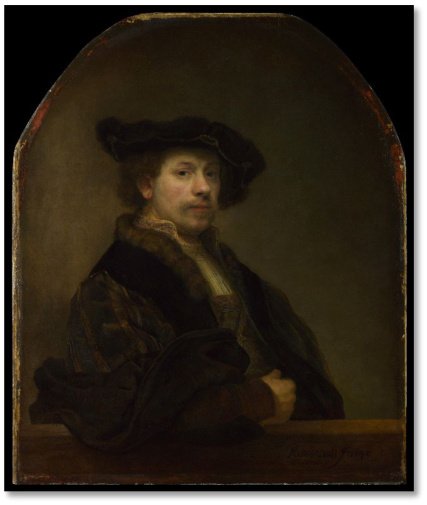
Rembrandt Self-portrait at the age of 34 , 1640, oil on canvas, 102 x 80cm
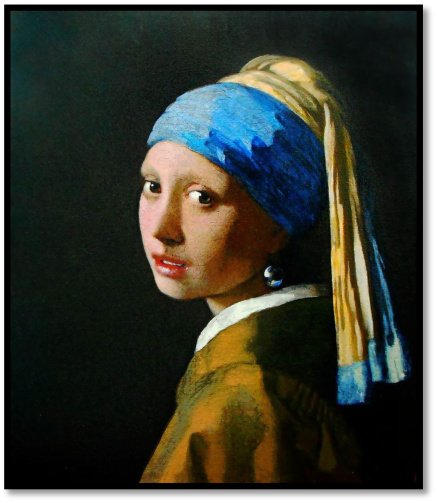
Vermeer, Girl with a Pearl Earring, 1665, oil on canvas, 115.4 x 99cm
Stilleven , or still life boomed in popularity in the 17th century and was used to imaginatively express beauty as well as the philosophical climate of the times through strategically composed arrangements and groupings of inanimate objects.
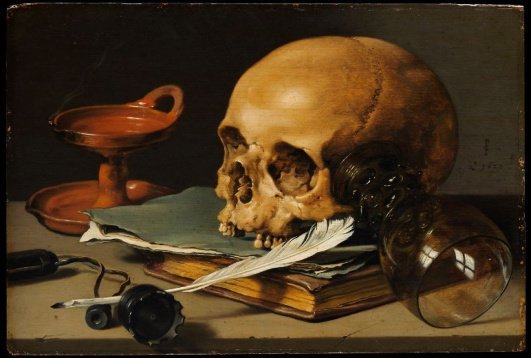
Vanitas is a 17th -century Dutch still life painting genre with symbols of death or a passing of time. Vanitas ‘featured objects such as hourglasses, skulls, and candles; symbols to remind the viewer that while life may be full of riches, death is inevitable.
Pieter Claesz, Still Life with a Skull and a Writing Quill , oil on wood, 1628, 24.1 x 35.9cm.
2
Page 4
Form II Art History Supplementary Material
Read pages 222-225 of the textbook, ART – The Whole Story and answer the questions below:
-
What historical event gave the Dutch Republic its independence?
-
Why is Frans Hals’ A Banquet of the officers of the St George Militia Company characteristic of the Dutch Golden Age and a break from convention?
-
Describe ‘genre painting’ and note one artist who exemplifies it.
-
What does ‘vanitas’ mean in art historical terms?
-
Give TWO examples of symbolism found in vanitas painting.
3
Page 5
Form II Art History Supplementary Material
Johannes (Jan) Vermeer (1632-75)
•The foremost Dutch painter of interior scenes was Jan Vermeer (1632 to 1675) of Delft (South Holland).
•Vermeer derived most of his income from his work as an innkeeper and art dealer, and he completed no more than 35 paintings that can be definitively attributed to him.
•Flemish artists had frequently painted domestic interiors, but sacred personages often occupied those scenes.
•In contrast, Vermeer and his contemporaries composed neat, quietly opulent interiors of Dutch middle-class homes with men, women, and children engaging in household tasks or at leisure.
•Women are the primary protagonists of Vermeer's paintings, which are highly idealised depictions of the social values of Dutch Burghers.
•Vermeer, like Rembrandt, was a master of pictorial light and used it with immense virtuosity. He could render space so convincingly through his depiction of light that in his works, the picture surface functions as an invisible glass pane through which the viewer looks into the constructed illusion.
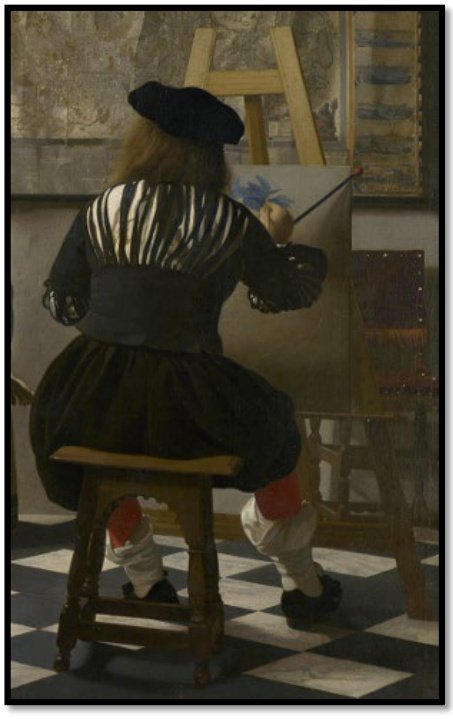
Jan Vermeer, The Art of Painting (detail), 1662, oil on canvas, 120 x 100cm
•Art historians believe Vermeer used both mirrors and the camera obscura as drawing tools.
•Vermeer did not simply copy the cameras image however instead the camera obscura and mirrors helped him obtain results he reworked compositionally placing his figures and the furniture of a room in beautiful stability.
Source: Gardner’s Art through the Ages
Sacred personages: A sacred personage is an individual revered for their spiritual significance, often associated with divinity, religious authority, or profound moral integrity. This can include figures such as prophets, saints, or deities within various religious traditions.
Protagonist meaning: The principal or main character in a work, such as a drama, a story, a painting.
Burgher means ‘citizen’ in Dutch.
4
Page 6
Form II Art History Supplementary Material
Read pages 228-229 of the textbook, ART – The Whole Story and answer the questions on the following page:
-
Describe the composition and subject matter of the painting.
-
How has Vermeer brought a sense of ‘dramatic impact’ to the painting?
-
How has the artist rendered the various surfaces in the painting?
-
What is ‘Delftware’ and how is it seen in the painting?
5
Page 7
Form II Art History Supplementary Material
Notes
6
Page 8
Form II Art History Supplementary Material
Extension Reading


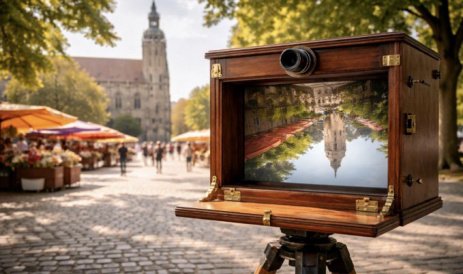
CAMERA OBSCURA – what is it?
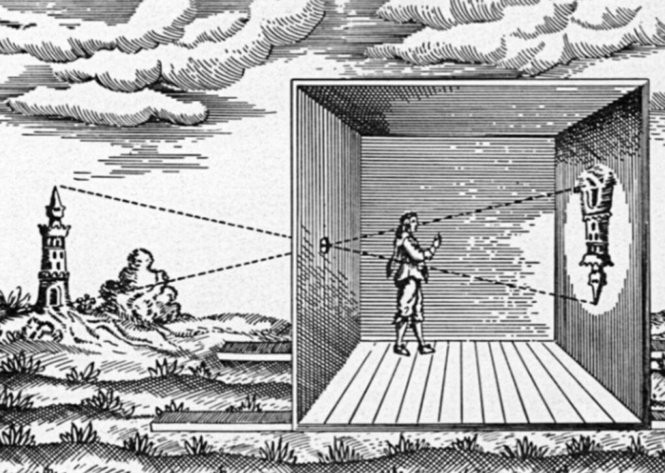
The name comes from the Latin words for 'dark' (obscura) and 'room' (camera).
With a camera obscura, you can perfectly capture the world around you by projecting what's on the outside down into a darkened space on the inside.
And you don't need a power source.
That means it's not 'magic' — but it is useful science.
Camera obscura — and before them, pinhole cameras — have been around for several hundred years.
But it wasn't until the early 1600s CE that we were able to manufacture lenses of high enough quality to create more flexible cameras with larger openings (apertures). That meant letting in more light to create brighter, higher-quality images.
Draughtsman and painters would once have used a camera obscura like this for making accurate, detailed sketches of scenes — like landscapes or architecture.
It was particularly useful for capturing perspective — accurately representing the height, width, depth and relative position of what you can see in the 3D world on a 2D flat surface.
HOW DOES IT WORK?
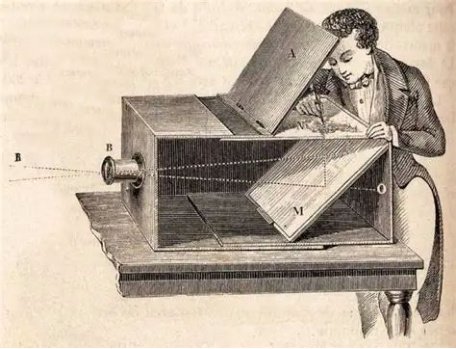
That lens focuses the light from the scene outside down onto a mirror which is held at a 45-degree angle behind it on the inside.
The mirror reflects the rays of light onto a piece of paper — or canvas — laid out flat on the base inside the wooden box.
To see the image, you need to cover yourself with a piece of black cloth to stop any other surrounding light from getting into the box. You'd then trace the outlines of the scene you can see projected onto the paper inside.
And because this camera obscura uses a lens, which creates a relatively large aperture, you get a sharp, colourful image on the paper — like a mini video feed of the outside world.

7
Page 9
Form II Art History Supplementary Material
WHO USED A CAMERA OBSCURA?
Because the light is bouncing off the mirror, you see the image the right way up. But the lens causes the image to flip (or invert) so it's also the wrong way round.
That meant artists using a camera obscura would have to trace the final image in reverse.
There is plenty of evidence that masters like Canaletto and Rembrandt used the camera obscura — but other artists may have been more secretive.
People still debate whether the Dutch painter Johannes Vermeer used a camera obscura to capture the incredible detail in his exquisite paintings of domestic scenes. Although there's no written evidence to prove it either way, art historians think, on balance, that he probably did!
THE BIRTH OF PHOTOGRAPHY
In the 1700s and 1800s CE, the camera obscura was also a useful accessory for the wealthy taking the ‘Grand Tour’ to make drawings of Italian landscapes or classical ruins.
But the camera obscura is only focusing and reflecting light — not capturing it.
The next big leap in the 1800s CE was to combine a device like a camera obscura with a material that would alter when exposed to the light — and preserve the image.
That's how this photograph was taken. Called View from the Window at Le Gras , it's the earliest known photograph. The Frenchman Joseph Niépce took it in 1826 or 1827 using a camera obscura and a plate coated with chemicals.
So even though the camera obscura isn't magic — it is rather magical.
With just a hole and some light, we have the starting point for all photography, including — believe it or not — the camera in your phone!
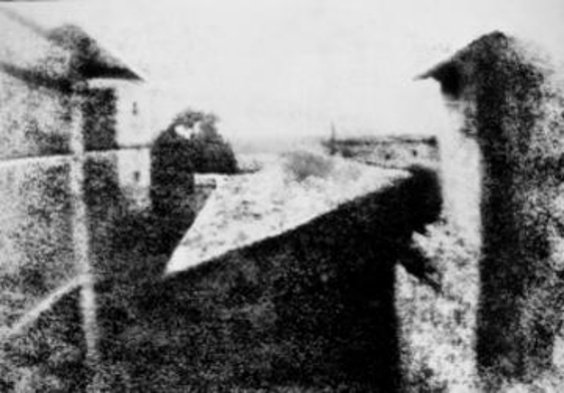
View from the Window at Le Gras taken by Joseph Niepce c. 1826/27
8
Page 10
Form II Art History Supplementary Material
9
Page 11
Form II Art History Supplementary Material
10