Textbook pp. 118-119
Page 1
Text below is OCR output and may contain recognition errors.
|
EARLY
ITALIAN ART
©
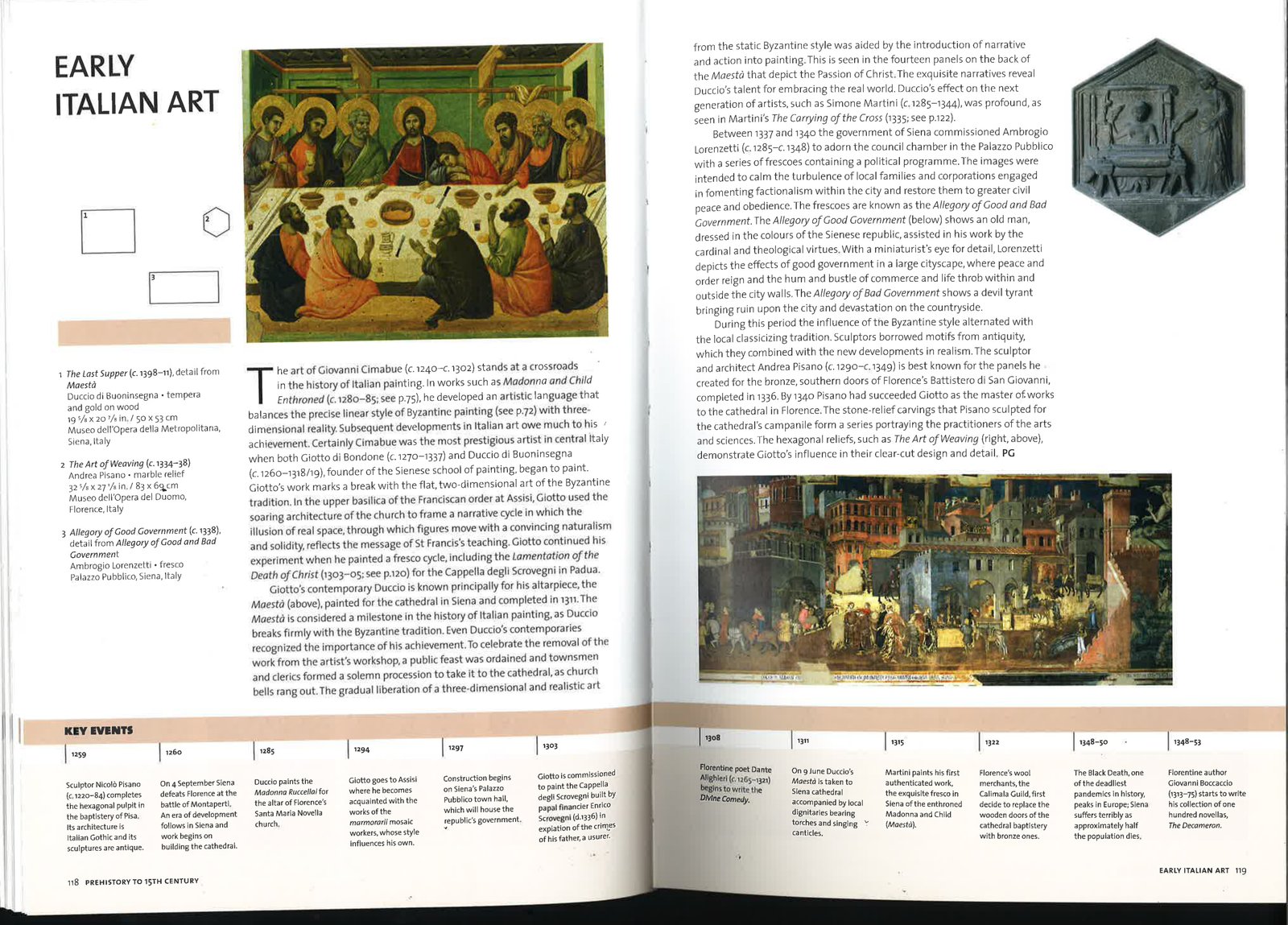
4 The Last Supper (c. 1398-11), detail from
Maesta
Duccio di Buoninsegna + tempera
and gold on wood
19 5/s x 20 7/e in. / 50 X53.cM Museo dell’Opera della Metropolitana,
Siena, Italy
2 The Art of Weaving (c. 1334-38) Andrea Pisano « marble relief 32 5/e x 27 Vein, / 83 X 6gcm Museo dell’Opera del Duomo,
Florence, Italy
3 Allegory of Good Government (c. 1338), detail from Allegory of Good and Bad
Government
Ambrogio Lorenzetti « fresco Palazzo Pubblico, Siena, Italy
KEY EVENTS
1259
Sculptor Nicolé Pisano (c.1220-84) completes the hexagonal pulpit in the baptistery of Pisa. Its architecture Is Italian Gothic and its sculptures are antique.
1260
On 4 September Siena defeats Florence at the battle of Montaperti, An era of development follows in Siena and work begins on building the cathedral.
118 PREHISTORY TO 15TH CENTURY
he art of Giovanni Cimabue (c. 1240-c. 1302) stands ata crossroads
in the history of Italian painting. In works such as Madonna and Child
Enthroned (c. 1280-85; see p.75), he developed an artistic language that balances the precise linear style of Byzantine painting (see p.72) with three- dimensional reality. Subsequent developments in Italian art owe much to his / achievernent. Certainly Cimabue was the most prestigious artist in central Italy when both Giotto di Bondone (c. 1270-1337) and Duccio di Buoninsegna (c.1260-1318/19), founder of the Sienese school of painting, began to paint. Giotto’s work marks a break with the flat, two-dimensional art of the Byzantine tradition. In the upper basilica of the Franciscan order at Assisi, Giotto used the soaring architecture of the church to frame a narrative cycle in which the illusion of real space, through which figures move with a convincing naturalism and solidity, reflects the message of St Francis’s teaching. Giotto continued his experiment when he painted a fresco cycle, including the Lamentation of the Death of Christ (1303-05; see p.120) for the Cappella degli Scrovegni in Padua.
Giotto’s contemporary Duccio is known principally for his altarpiece, the
Maesta (above), painted for the cathedral in Siena and com pleted in 1311. The Maesta is considered a milestone in the history of Italian painting, as Duccio breaks firmly with the Byzantine tradition. Even Duccio’s contemporaries recognized the importance of his achievement, To celebrate the removal of the work ftom the artist’s workshop, a public feast was ordained and townsmen and clerics formed a solemn procession to take it to the cathedral, as church bells rang out. The gradual liberation of a three-dimensional and realistic art
1285 1294 1297 4303
Giotto is commissioned
from the static Byzantine style was aided by the introduction of narrative and action into painting. This is seen in the fourteen panels on the back of the Maesta that depict the Passion of Christ. The exquisite narratives reveal Duccio’s talent for embracing the real world. Duccio’s effect on the next generation of artists, such as Simone Martini (c.1285—-1344), was profound, as seen in Martini’s The Carrying of the Cross (1335; see p.122).
Between 1337 and 1340 the government of Siena commissioned Ambrogio Lorenzetti (c.1285—-c. 1348) to adorn the council chamber in the Palazzo Pubblico with a series of frescoes containing a political programme. The images were intended to calm the turbulence of local families and corporations engaged in fomenting factionalism within the city and restore them to greater civil peace and obedience. The frescoes are known as the Allegory of Good and Bad Government. The Allegory of Good Government (below) shows an old man, dressed in the colours of the Sienese republic, assisted in his work by the cardinal and theological virtues. With a miniaturist’s eye for detail, Lorenzetti depicts the effects of good government ina large cityscape, where peace and order reign and the hum and bustle of commerce and life throb within and outside the city walls. The Allegory of Bad Government shows a devil tyrant bringing ruin upon the city and devastation on the countryside.
During this period the influence of the Byzantine style alternated with the local classicizing tradition. Sculptors borrowed motifs from antiquity, which they combined with the new developments in realism. The sculptor and architect Andrea Pisano (c.1290-c. 1349) is best known for the panels he created for the bronze, southern doors of Florence’s Battistero di San Giovanni, completed in 1336. By 1340 Pisano had succeeded Giotto as the master of works to the cathedral in Florence. The stone-relief carvings that Pisano sculpted for the cathedral’s campanile form a series portraying the practitioners of the arts and sciences. The hexagonal reliefs, such as The Art of Weaving (right, above), demonstrate Giotto’s influence in their clear-cut design and detail. PG
1308
Florentine poet Dante On g June Duccio’s
Duccio paints the Madonna Ruccellai for the altar of Florence's Santa Maria Novella church.
Giotto goes to Assisi where he becomes acquainted with the works of the marmorarii mosaic workers, whose style influences his own.
Construction begins on Siena’s Palazzo Pubblico town hall, which will house the
republic’s government.
to paint the Cappella degli Scrovegni built by papal financier Enrico Scrovegni (d.1336) in expiation of the crimes of his father, a usurer-
Allghier] (¢.13265~4321) beginstowitethe Divine Comedy,
Maestd is taken to Siena cathedral accompanied by local dignitaries bearing torches and singing ¥ canticles.
Martini paints his first authenticated work, the exquisite fresco in Siena of the enthroned Madonna and Child (Maesta).
Florence's wool merchants, the Calimala Guild, first decide to replace the wooden doors of the cathedral baptistery with bronze ones.
1348-50
The Black Death, one of the deadliest pandemics in history, peaks in Europe; Siena suffers terribly as approximately half the population dies,
1348-53
Florentine author Giovanni Boccaccio (1313-75) starts to write his collection of one hundred novellas,
The Decameron.
EARLY ITALIAN ART 119