Textbook pp. 212-215
Page 1
Text below is OCR output and may contain recognition errors.
BAROQUE
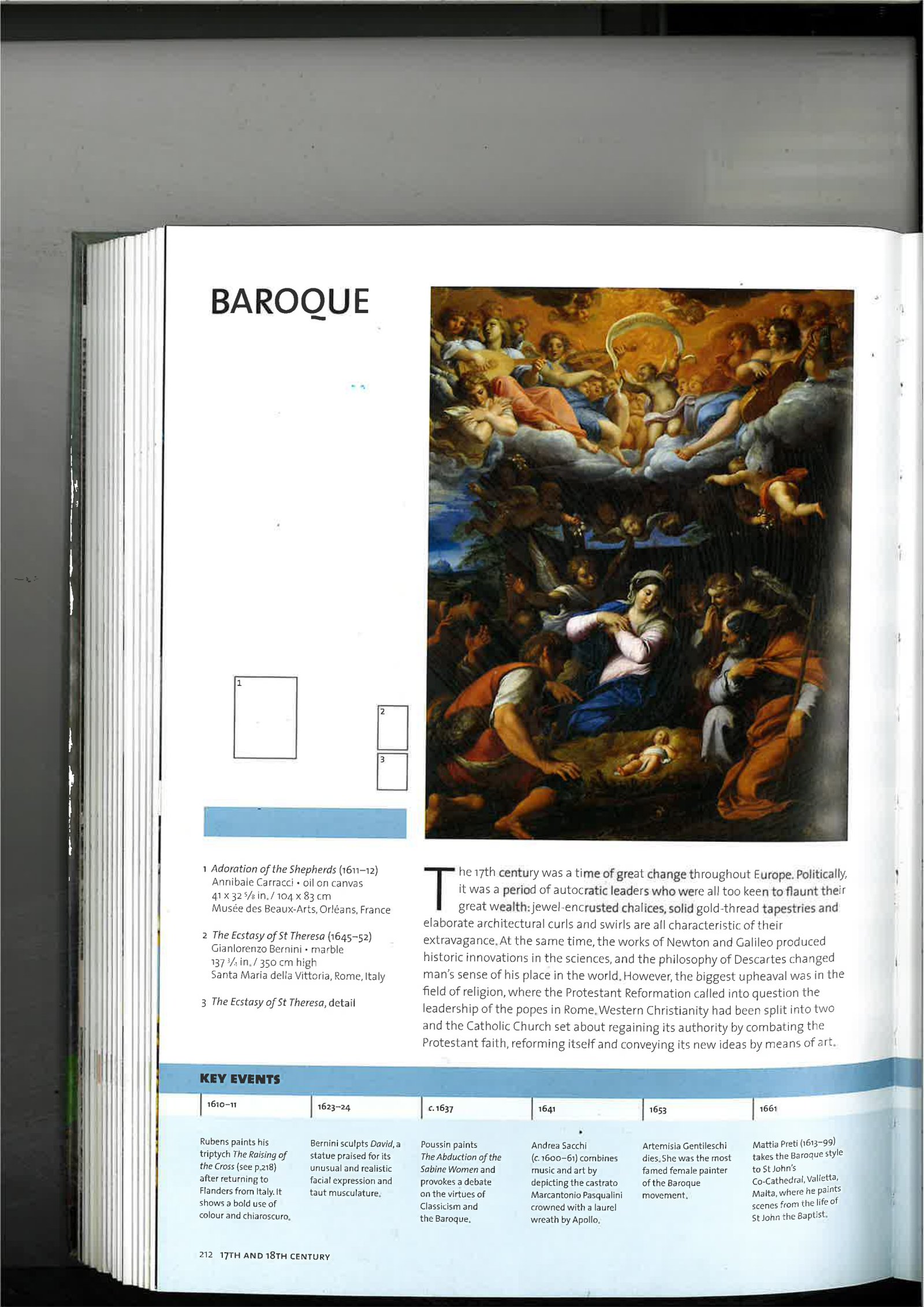
1 Adoration of the Shepherds (1611-12) Annibale Carracci + oil on canvas 41 X 325/sin./ 104 x 83cm Musée des Beaux-Arts, Orléans, France 2 The Ecstasy of St Theresa (1645-52) Gianlorenzo Bernini +» marble 137 3/, in. / 350 cm high Santa Maria della Vittoria, Rome, Italy
3 The Ecstasy of St Theresa, detail
he 17th century was a time of great change throughout Europe. Politically, i it was a period of autocratic leaders who were all too keen to flaunt their great wealth: jewel-encrusted chalices, solid gold-thread tapestries and elaborate architectural curls and swirls are all characteristic of their extravagance, At the same time, the works of Newton and Galileo produced historic innovations in the sciences, and the philosophy of Descartes changed \ man’s sense of his place in the world. However, the biggest upheaval was in the field of religion, where the Protestant Reformation called into question the leadership of the popes in Rome, Western Christianity had been split into two and the Catholic Church set about regaining its authority by combating the Protestant faith, reforming itself and conveying its new ideas by means of art.
KEY EVENTS
1610-11 1623-24
Rubens paints his Bernini sculpts David, a triptych The Raising of statue praised for its the Cross {see p.218} unusual and realistic after returning to facial expression and Flanders from Italy. It taut musculature,
shows a bold use of colour and chiaroscuro,
212 17TH AND 18TH CENTURY
c.1637 1641 | 165s 1661
Poussin paints Andrea Sacchi Artemisia Gentileschi Mattia Preti noua
The Abduction of the (c. 1600-61) combines dies. She was the most takes the Be roqu
Sabine Women and music and art by famed female painter to St John’s vale
provokes a debate depicting the castrato of the Baroque eee" a aa on the virtues of Marcantonio Pasqualini movement. Malta, where he He i 4 Classicism and crowned with a laurel scenes Fron ae
the Baroque. wreath by Apollo. St John the Bap
Page 2
Text below is OCR output and may contain recognition errors.
ighout Europe. Politically, '
| too keen to flaunt their |-thread tapestries and ‘istic of their
ind Galileo produced
of Descartes changed rest upheaval was in the d into question the
iad been split into two ty by combating the ideas by means of art.
1661
chi Mattia Preti (1613-99) vost takes the Baroque style ter to St John’s Co-Cathedral, Valletta, Malta, where he paints scenes from the life of 4 St John the Baptist
The strategies for this Counter-Reformation were laid out during the Council of Trent (1545-63), which emphasized the propagation of religious ideals via the medium of pictures, and demanded greater accuracy in the depiction of biblical narratives and the use of images to arouse new religious fervour. ; The term ‘Baroque’ was initially a derogatory one, introduced by critics of a later generation wishing to discredit the art that had preceded them. The word ‘baroque’ means ‘misshapen’, and refers to the typically flowing, quasi-endless forms associated with the style. It is used to designate the art, architecture and
‘music that followed the Late Renaissance and preceded the Rococo (see p.250)
period, Seen as a reaction to the mannered style in vogue at the end of the 16th century, in which classical idealism had given way to placid beauty, the Baroque is particularly associated with art that was commissioned by the Catholic Church. It is characterized by heavy ornamentation, complex but systematized design and a luxuriant deployment of colour, light and shade.
Rome is the city most associated with the Baroque. It became the international centre of artistic production, artistic debate and, owing to the presence of the papacy, of artistic commissions. Artists from across Europe came to study the art of classical antiquity and of the High Renaissance (see p.172), especially the works of Michelangelo (Michelangelo Buonarroti; 1475-1564) and Raphael (Raffaello Sanzio da Urbino; 1483-1520). From this city, Baroque ideals and visual characteristics were spread across Europe as artists returned home. The work of two Italian masters, Michelangelo Merisi da Caravaggio (1571-1610) and Annibale Carracci (c. 1560-1609), had the greatest impact at the start of the period. Although neither artist was born in Rome, both produced work in the city. In his native Bologna, Annibale Carracci, along with his brother Agostino (1557-1602) and his cousin Ludovico (1555-1619), started an art academy that promoted a commitment to truth, encouraging drawing from life and the study of classical antiquity. His work is typified by well-defined and solid figures, by the clear communication of the subject and a powerful emotional energy. Carracci’s style is full of movement, activity and colour. In Adoration of the Shepherds (opposite), Carracci demonstrates his knowledge of classical sculpture and his ability to create monumental and exuberant designs while at the same time appealing to viewers’ emotions, portraying beauty and avoiding detail. Carracci’s influence is seen in the works of Guercino (Giovanni Francesco Barbieri; 1591-1666), where movement is conveyed through the lines of the subjects’ flowing drapery. Guercino was a prolific artist and his work is also a testimony to the commercial opportunities of his time—he retired a rich man after completing 106 altarpieces and almost 150 other paintings.
Caravaggio desired to depict the world faithfully, in truthful images. His naturalism is characterized not by beauty but by a frankness that often resulted in the depiction of a gritty reality. The most influential aspect of his work is his use of dramatic light and shade, as seen in The Conversion of St Paul (see:p.216), painted between 1600 and 1601. His style was copied throughout Europe, creating schools of followers whose work is defined as ‘Ca ravaggesque.
16 =a mn = | RB 1682 | 1601-94 1701
Giovanni Pietro
Bellor’s Thetives ofthe anoWned landscape Master of ceiling The outstanding Modern Painters, Painter Lorrain ; decoration Andrea Baroque court painter Sculptors and Architect ge Bece alts Pozzo (1642-1709) Hyacinthe Rigaud is published ects and the Stag in the paints The Entrance (1659-1743) is i year of his death. of St ignatius into commissioned to paint Paradise in Sant’ French king, Louis XIV. Ignazio, Rome.
N15 1723-25 Building begins on The Spanish Steps are Vienna’s magnificent built in Rome. It is the Karlskirche. It is longest staircase in designed by Austrian Europe and an urban architect Jo monument in the Fischer von Erl: Baroque style.
(1656-1723).
BAROQUE 213
Page 3
Text below is OCR output and may contain recognition errors.
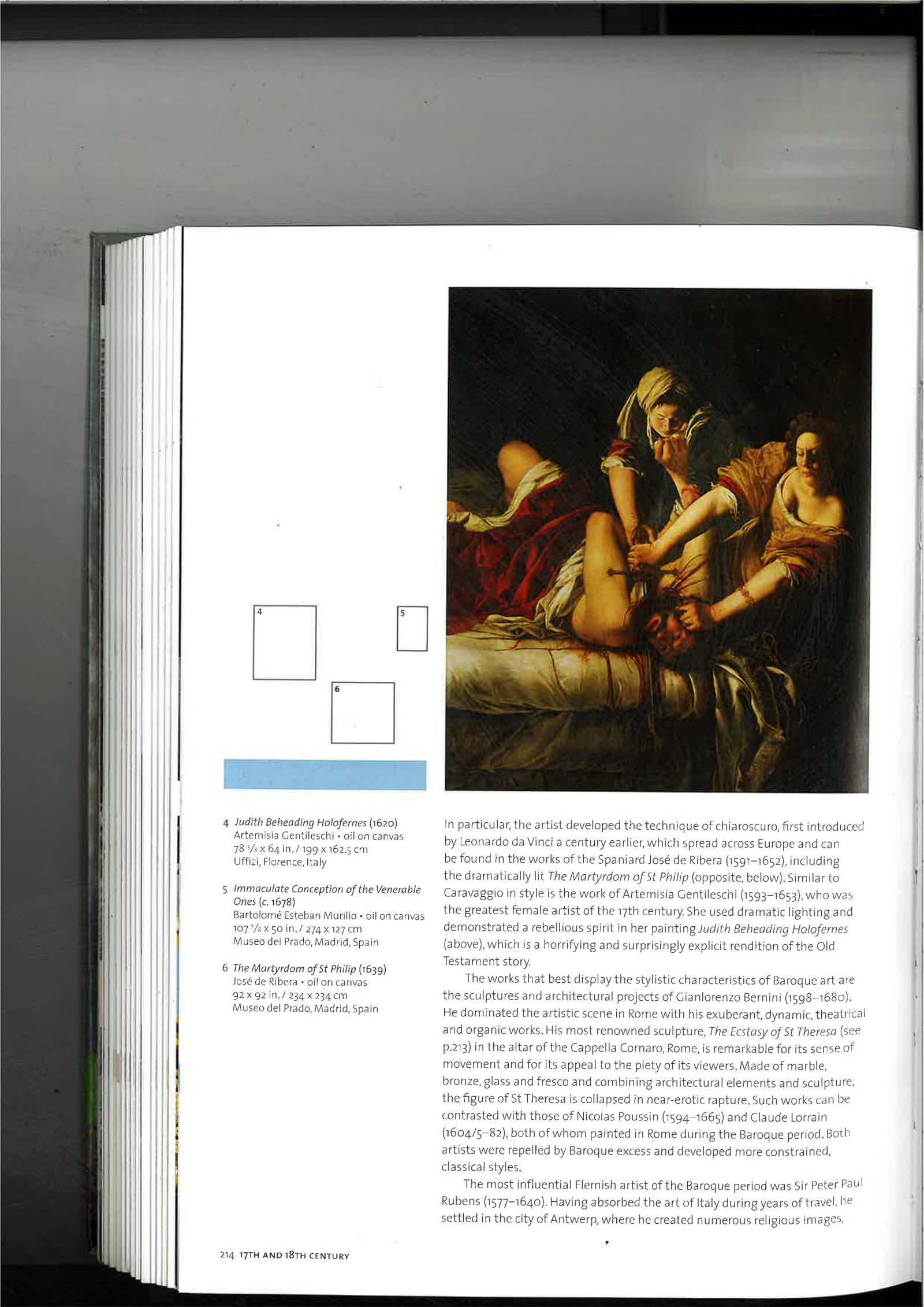
Artemisia Gentileschi + oil on canvas 78 3/s x 64 in. / 199 x 162.5 cm Uffizi, Florence, Italy
wi
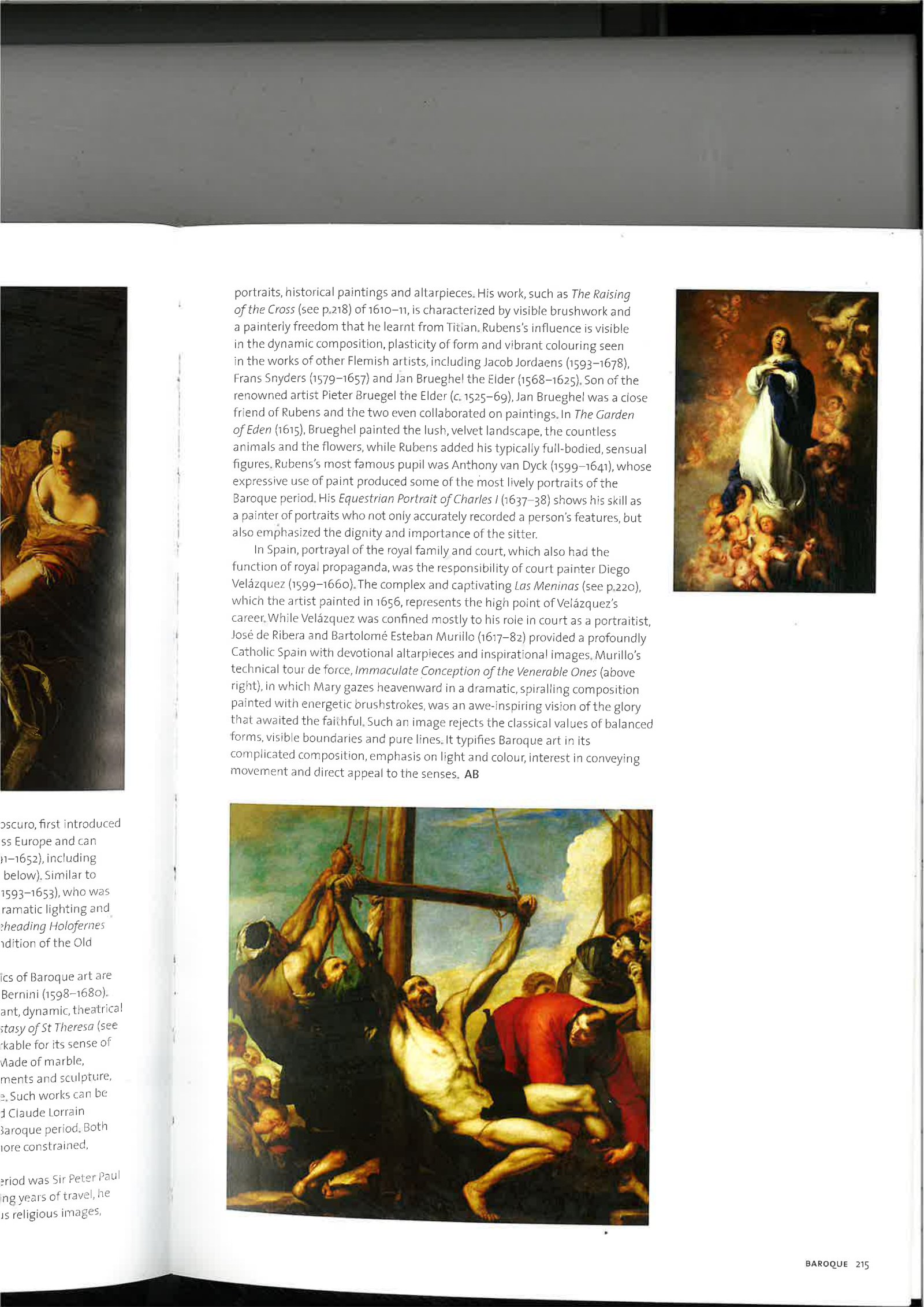
Immaculate Conception of the Venerable Ones (c. 1678)
Bartolomé Esteban Murillo + oil on canvas { 107 */s x 50 in. / 274 x 127 cm
| Museo del Prado, Madrid, Spain
4 Judith Beheading Holofernes (1620)
The Martyrdom of St Philip (1639) José de Ribera + oi on canvas
92 x 92 in. / 234 x 234cm
Museo del Prado, Madrid, Spain
an
214 17TH AND 18TH CENTURY
In particular, the artist developed the technique of chiaroscuro, first introduced by Leonardo da Vinci a century earlier, which spread across Europe and can be found in the works of the Spaniard José de Ribera (1591-1652), including the dramatically lit The Martyrdom of St Philip (opposite, below). Similar to Caravaggio in style is the work of Artemisia Gentileschi (1593-1653), who was the greatest female artist of the 17th century. She used dramatic lighting and demonstrated a rebellious spirit in her painting Judith Beheading Holofernes (above), which is a horrifying and surprisingly explicit rendition of the Old Testament story.
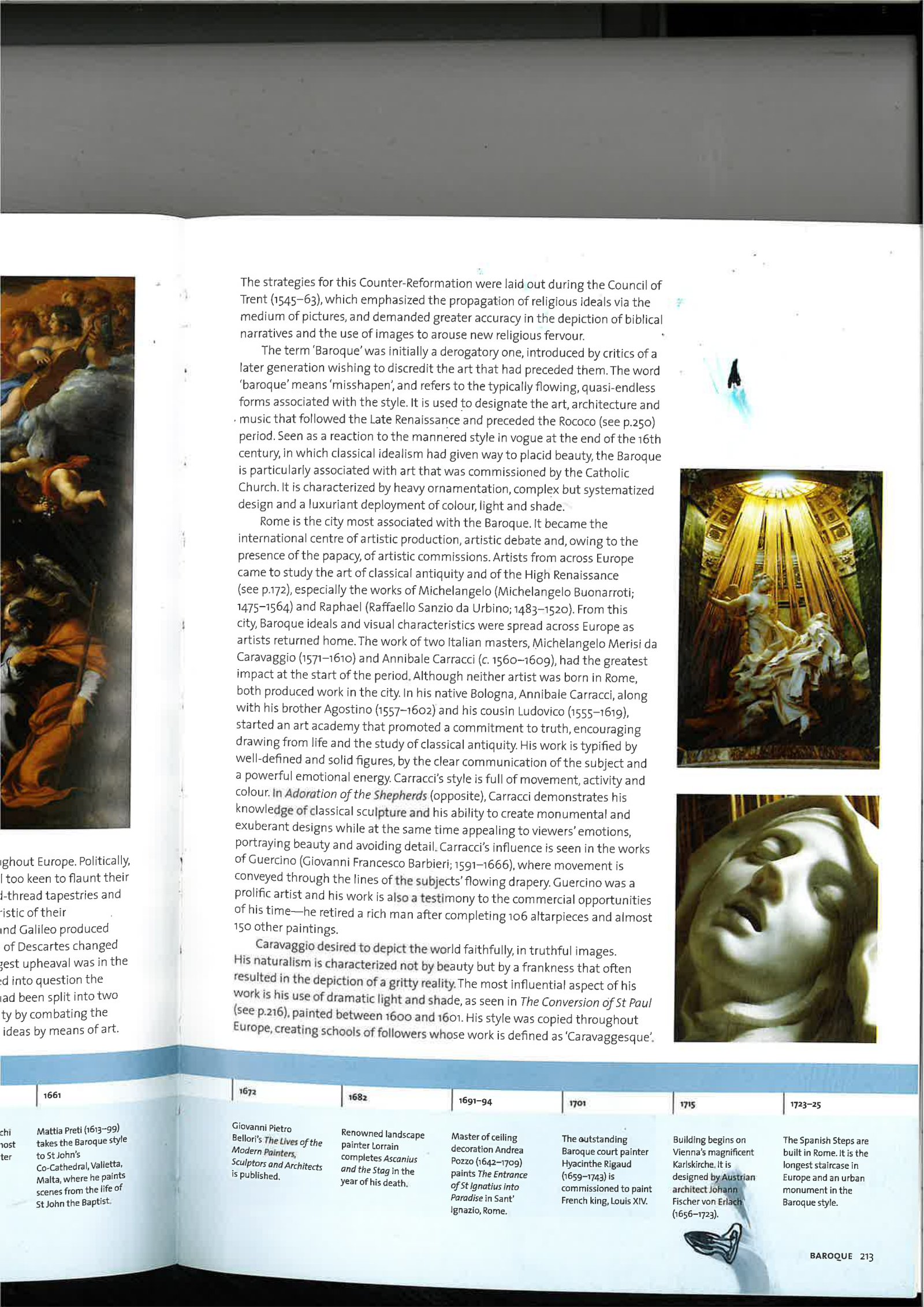
The works that best display the stylistic characteristics of Baroque art are the sculptures and architectural projects of Gianlorenzo Bernini (1598-1680). He dominated the artistic scene in Rome with his exuberant, dynamic, theatrical and organic works, His most renowned sculpture, The Ecstasy of St Theresa (see p-213) in the altar of the Cappella Cornaro, Rome, is remarkable for its sense of movement and for its appeal to the piety of its viewers. Made of marble, bronze, glass and fresco and combining architectural elements and sculpture, the figure of St Theresa is collapsed in near-erotic rapture. Such works can be contrasted with those of Nicolas Poussin (1594-1665) and Claude Lorrain (1604/5—82), both of whom painted in Rome during the Baroque period. Both artists were repelled by Baroque excess and developed more constrained, classical styles.
The most influential Flemish artist of the Baroque period was Sir Peter Paul Rubens (1577-1640). Having absorbed the art of Italy during years of travel, he settled in the city of Antwerp, where he created numerous religious images,
a
——~ .
—_==
Page 4
Text below is OCR output and may contain recognition errors.
portraits, historical paintings and altarpieces. His work, such as The Raising of the Cross (see p.218) of 1610-11, is characterized by visible brushwork and a painterly freedom that he learnt from Titian. Rubens's influence is visible in the dynamic composition, plasticity of form and vibrant colouring seen
in the works of other Flemish artists, including Jacob Jordaens (1593-1678),
4 Frans Snyders (1579-1657) and Jan Brueghe! the Elder (1568-1625). Son of the renowned artist Pieter Bruegel the Elder (c. 1525-69), Jan Brueghel was a close friend of Rubens and the two even collaborated on paintings. In The Garden of Eden (1615), Brueghel painted the lush, velvet landscape, the countless animals and the flowers, while Rubens added his typically full-bodied, sensual figures. Rubens’s most famous pupil was Anthony van Dyck (1599-1641), whose expressive use of paint produced some of the most lively portraits of the Baroque period, His Equestrian Portrait of Charles | (1637-38) shows his skill as a painter of portraits who not only accurately recorded a person’s features, but also emphasized the dignity and importance of the sitter.
In Spain, portrayal of the royal family and court, which also had the function of royal propaganda, was the responsibility of court painter Diego Velazquez (1599-1660). The complex and captivating Las Meninas (see p.220), which the artist painted in 1656, represents the high point of Velazquez’s career, While Velazquez was confined mostly to his role in court as a portraitist,
i Jose de Ribera and Bartolomé Esteban Murillo (1617-82) provided a profoundly Catholic Spain with devotional altarpieces and inspirational images. Murillo’s technical tour de force, Immaculate Conception of the Venerable Ones (above right), in which Mary gazes heavenward in a dramatic, spiralling composition painted with energetic brushstrokes, was an awe-inspiring vision of the glory that awaited the faithful. Such an image rejects the classical values of balanced forms, visible boundaries and pure lines. It typifies Baroque art in its complicated composition, emphasis on light and colour, interest in conveying movement and direct appeal to the senses. AB
ascuro, first introduced ss Europe and can 11-1652}, including below}. Similar to 1593-1653), who was ramatic lighting and >heading Holofernes \dition of the Old
ics of Baroque art are Bernini (1598-1680). ant, dynamic, theatrical stasy of St Theresa (see ‘kable for its sense of ade of marble,
ments and sculpture, >, Such works can be
4 Claude Lorrain 3aroque period. Both iore constrained,
sriod was Sir Peter Paul ng years of travel, he 1s religious images,
BAROQUE 215
mm ——ss—(‘“iésCSsSCS*