Cycle 19: High Renaissance, Raphael
Page 1
Form II Art History Supplementary Material
Cycle 19 – High Renaissance III
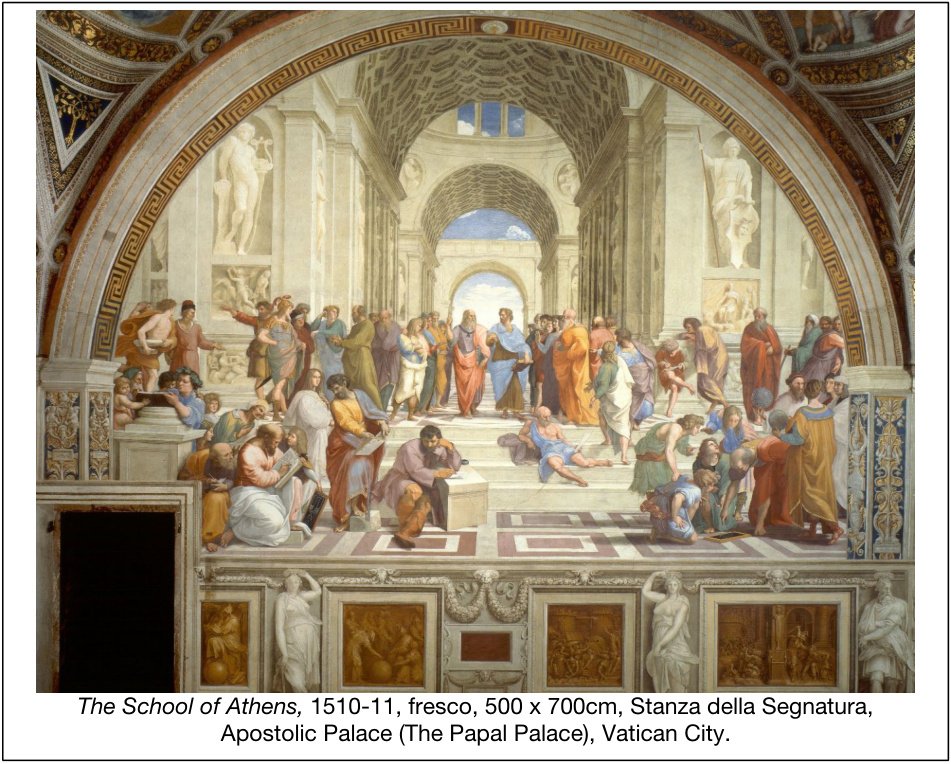
The School of Athens, 1510-11, fresco, 500 x 700cm, Stanza della Segnatura,
Apostolic Palace (The Papal Palace), Vatican City.
Name: __________________________________________________ House / Tutor: ___________________ Master: _______________
Page 2
Form II Art History Supplementary Material
Raphael (1483-1520)
-
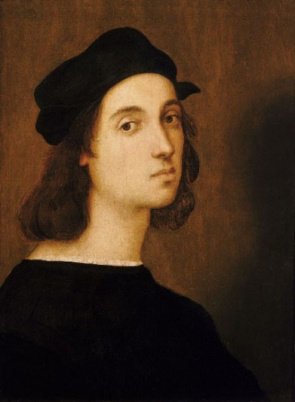
Raphaello Sanzio da Urbino - commonly known as Raphael –
-
was an Italian painter and architect of the High Renaissance.
-
He was a contemporary of Leonardo and Michelangelo and
-
together, these three became known as the greatest artists of the Renaissance.
-
While only living to 37, Raphael was a productive painter and
-
left an extensive body of work. He ran a large workshop after first training under the painter Perugino.
-
Raphael grew up in Urbino but moved to Rome to complete
-
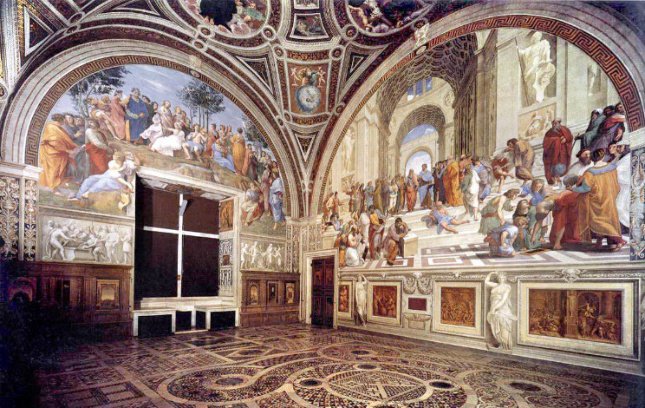
an important commission for Pope Julius II in the Vatican – a room called the Stanza della Segnatura.
-
The Stanza della Segnatura (Room of the Signatura), was the library of Pope Julius II. Raphael decorated the room according to four different aspects of knowledge:
- philosophy, theology, poetry and jurisprudence. The themes of this room represent a harmonious synthesis of Ancient Greek philosophy and Christian doctrine.
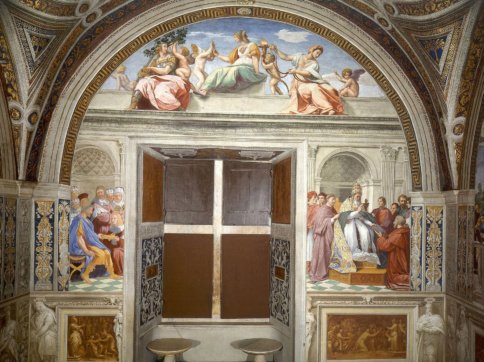
Cardinal and Theological Virtues. South wall of the Stanza della Segnatura.
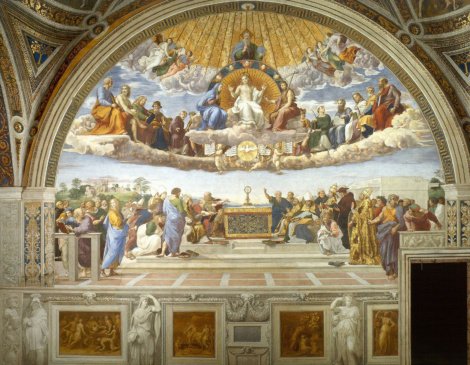
Disputation of the Holy Sacrament West wall of the Stanza della Segnatura.
1
Page 3
Form II Art History Supplementary Material
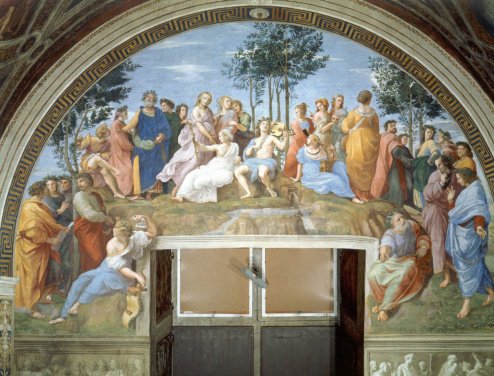
The Parnassus North wall of the Stanza della Segnatura.
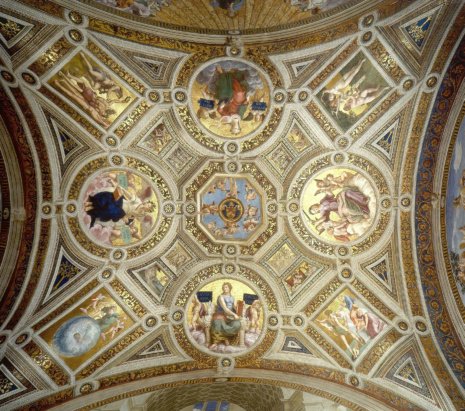
Ceiling
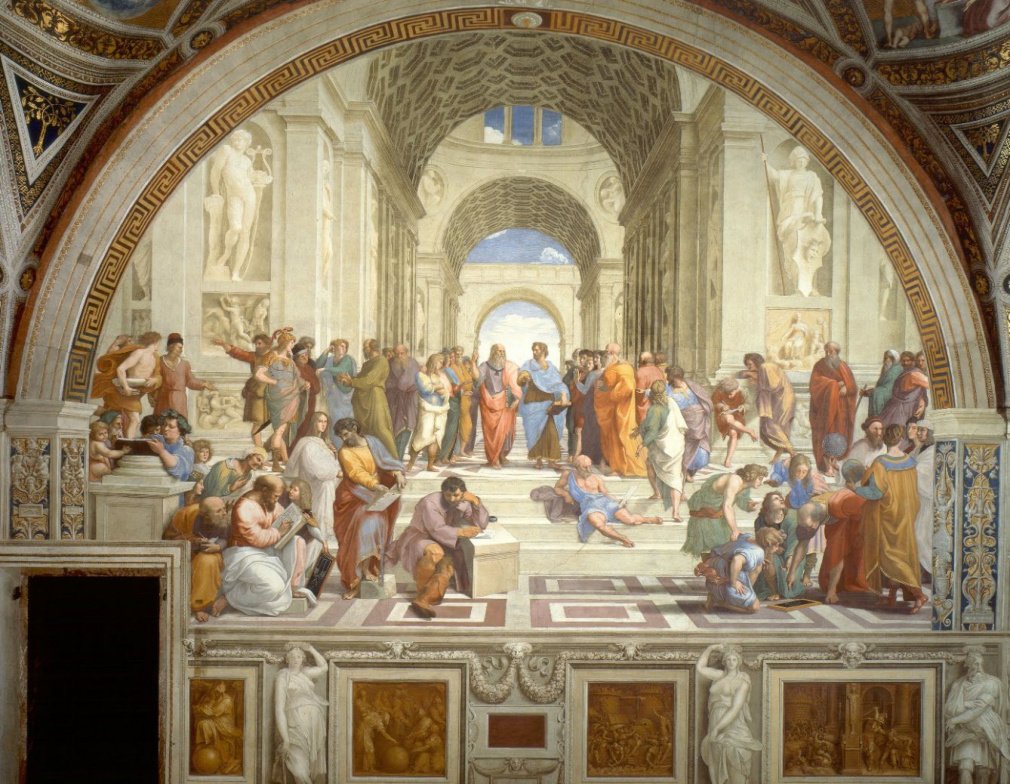

The School of Athens, 1510-11, fresco, 500x700cm.
East wall of the Stanza della Segnatura, Apostolic Palace (The Papal Palace), Vatican City.
2
Page 4
Form II Art History Supplementary Material
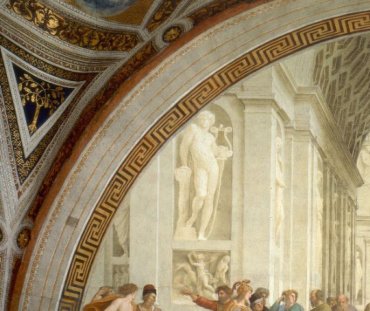
In The School of Athens, Raphael presents a fictitious scene - perhaps based on Plato’s ancient Academy - in which many of the most famous philosophers and mathematicians of the ancient world gather to engage in intellectual enquiry. The influence of Greek and Roman culture is evident throughout the fresco.
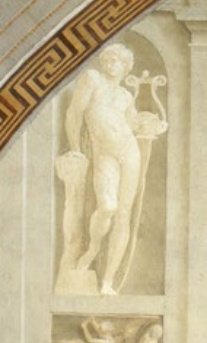
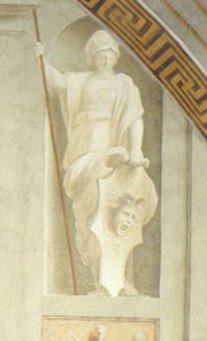
Statue of Apollo, holding a Minerva (Greek – Athena), lyre. The Greek god of light, Roman goddess of wisdom poetry and music. and defensive warfare.
The meander was a decorative motif popular in the Greek Geometric period (roughly 900-700BC).
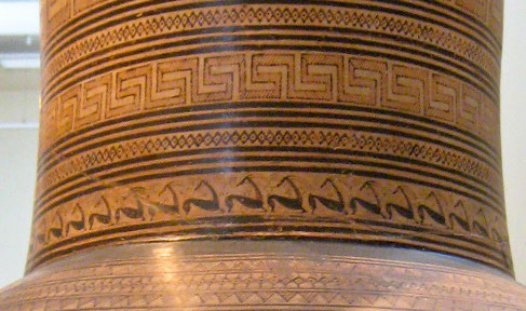
Greek Dipylon Amphora (detail) , 750BC
-
Plato, who appears as Leonardo da Vinci holds a copy of his philosophical treatise, the Timaeus. His upward gesture towards the heavens represents the immaterial nature of his idealist doctrine. In his Theory of Forms , Plato describes an abstract, unseen world which he believed represented the fundamental nature of reality based on the purity of mathematics.
-
Aristotle, depicted with his Nichomachean Ethics, extends his palm towards the ground, representing his empiricist views – the idea that knowledge is constructed through observation and experience. In his Ethics, Aristotle draws a link between happiness ( eudaimonia ), virtue and the pursuit of wisdom.
-
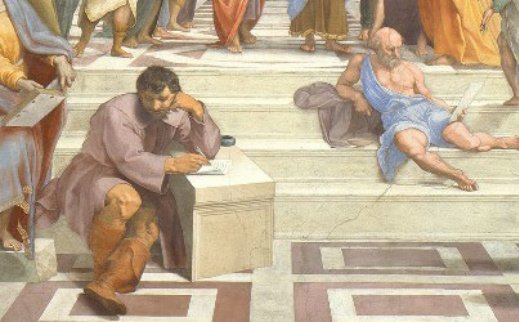
The two isolated figures in the foreground are Diogenes the Cynic (right) and Heraclitus (left).
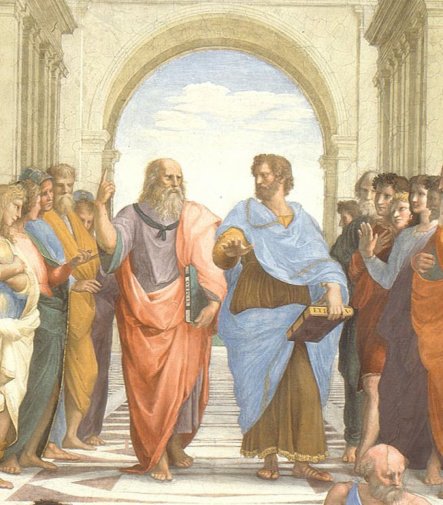
The Greek philosophers Plato (left) and Aristotle (right).
3
Page 5
Form II Art History Supplementary Material
-
Diogenes lived on the street and begged for a living. He criticised social mores and social institutions.
-
Heraclitus, who has been modelled on Michelangelo, and perhaps shared his melancholy temperament, was a preSocratic philosopher who believed in a doctrine of flux or constant change. According to the Greek historian Plutarch, Heraclitus stated that one cannot step in the same river twice.
Class questions
Watch: https://www.khanacademy.org/humanities/ap-art-history/early-europe-and-colonial- americas/renaissance-art-europe-ap/v/raphael-school-of-athens and answer the questions.
-
What evidence is there of Michelangelo’s influence on Raphael?
-
How can we identify Plato from Aristotle?
-
What is the significance of the gestures of Plato and Aristotle?
-
Describe the symbolism of the different colours Plato and Aristotle wear.
-
How has Euclid been depicted? What is the significance of Bramante serving as the model?
-
Describe the composition of The School of Athens.
4
Page 6
Form II Art History Supplementary Material
Extension question for class discussion:
Discuss how The School of Athens is characteristic of the Renaissance.
NOTES:

_____________________________________________________________________________
____________________________________________________________________________
5