Cycle 14: Proto-Renaissance, Giotto
Page 1
Form II Art History Supplementary Material
Cycle 14 – Proto-Renaissance - Giotto
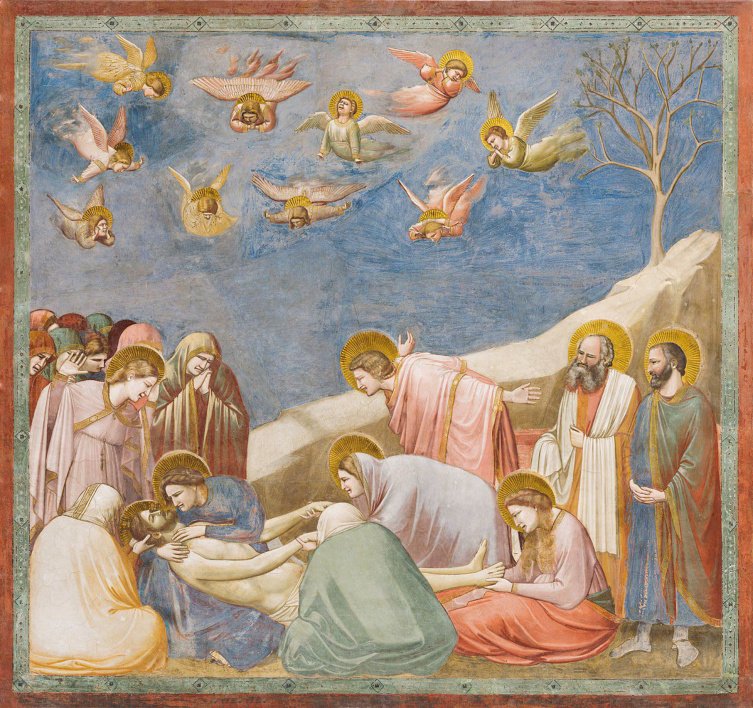
Giotto, Lamentation of the Death of Christ , fresco, 200 x 185 cm
Name: ___________________________________________________
House / Tutor: ____________________________________________
Master: _____________________________________________________
Page 2
Form II Art History Supplementary Material
Key Points
-
Renaissance – revival of classical antiquity
-
Humanism – focus on human potential, achievement, and individual experience
-
Fresco technique – water-based pigments are applied to freshly laid (wet) lime plaster
-
Strong emotional expression through gestures and facial expressions
-
Emphasis on human realism (more natural than Byzantine style)
-
Perspective and space – development of linear perspective to create depth and realism
-
Religious and secular themes – continued religious subjects, but growing inclusion of everyday life and mythology
Vocabulary:
-
Linear perspective
-
Aerial perspective
-
Fresco
-
Foreshortening
-
Pictorial space
-
Quattrocento
1
Page 3
Form II Art History Supplementary Material
GIOTTO DI BONDONE c.1267-1337 Florence, Italy
Cultural Frame – World
-
The word “renaissance” means ‘rebirth’ in French. The name, therefore, indicates a rebirth of interest in ancient Greece and Rome, and their art and culture.
-
The word ‘proto’ means first, especially from which other similar things develop; original.
-
The Renaissance refers to a period in European civilisation that was marked by a revival/rebirth of Classical learning and wisdom.
-
The Renaissance also saw many contributions to different fields, including new scientific laws, new forms of art and architecture, and new religious and political ideas.
-
During the Middle Ages, there were two institutions that controlled much of Europe. The Holy Roman Empire influenced the political life of the people. The Popes of the Roman Catholic Church controlled religious life. Both institutions began to lose power by the 1300s, and individual European nations also grew stronger.
-
People started writing in their own languages instead of Latin (the language of the Catholic church). People felt freer to think in new ways.
-
Before the Renaissance, most people in Europe placed great importance on God and religion. During the Renaissance, people began to think about the importance of humans as well. For this reason, these thinkers were called humanists.
-
Humanists wanted to make the most of their lives on Earth. They also wanted to understand the world around them.
-
The spirit of inquiry and discovery also led to a Renaissance in science. In the Middle Ages , scholars usually took their scientific knowledge from books. During the Renaissance, however, people began to experiment and observe for themselves.
-
Nicolaus Copernicus , who was born in Poland, was one of the greatest astronomers of the Renaissance. He showed that Earth revolves around the Sun. For more than 1,000 years before that, people had believed that everything in the universe revolved around Earth.
-
Some of the greatest Renaissance artists worked in Florence and in other cities in Italy . The rulers of Florence, the Medici family , spent great amounts of money to have artists create pictures, buildings, and statues
-
In 1550, Lives of the Most Eminent Painters, Sculptors and Architects was written and published by Giorgio Vasari (1511-1574), who is considered the first art historian in the modern sense. Vasari states that Cimabue and Giotto were the two painters who reset art on its true path following the Middle Ages. Vasari opens the first chapter of his book with Giotto.
-
Art is valued and artists are recognised as individuals, not simply craftsmen. Giotto was considered a great artist during this time and had a very successful and prosperous career. He enjoyed great personal fame.
-
Art patronage by the Church and state was common. The Scrovegni Chapel (also called the Arena Chapel) was commissioned by a wealthy private citizen, Enrico Scrovegni . This was possible because a wealthy merchant class was emerging.
-
Dante (1255-1321) wrote the Divine Comedy , summing up the beliefs of the medieval world in modern form; Giotto is mentioned in the Divine Comedy.
2
Page 4
Form II Art History Supplementary Material
Period: Proto-Renaissance
-
Leading artists of this period included:
-
Giotto di Bondone, (1276 - 1337),
-
Paolo Uccello (1397 – 1475)
-
Donatello (Donato di Niccolò, 1386 - 1466)
-
Filippo Brunelleschi, (1377 - 1446),
-
-
Artworks became more naturalistic, reflecting closer observation of the human form and nature, along with the development of the painting technique known as ‘perspective’.
What is perspective and how does it work?
Have you noticed that things look bigger if they are close to you and smaller if they are further away? This is perspective. It is perspective that helps make things look three-dimensional – and creates a sense of space receding into the distance. There are two types of perspective: linear perspective, and aerial perspective (sometimes called atmospheric perspective).
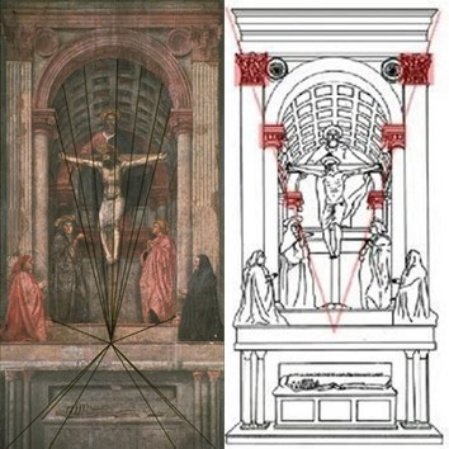
Masaccio, The Holy Trinity , 1426, fresco
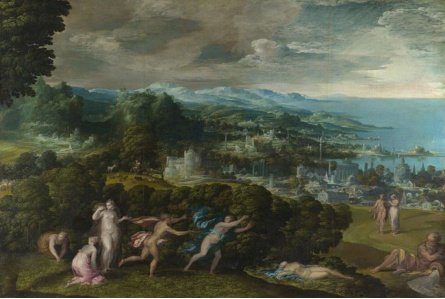
Nicolas Poussin, Landscape with Polyphemus , 1649, oil on canvas
Example of linear perspective
Example of aerial perspective
3
Page 5
Form II Art History Supplementary Material
FRESCO
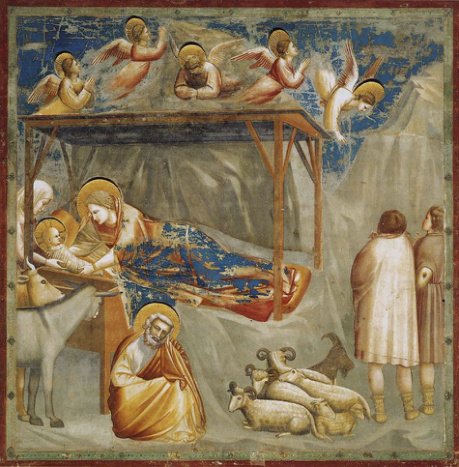
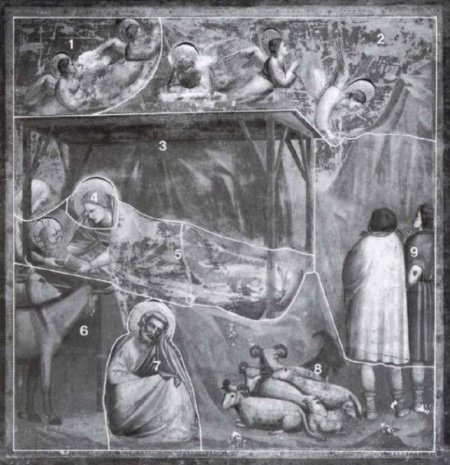
Scrovegni Chapel (also known as Arena Chapel). Left: The Nativity . Right: the ‘giornata’
Fresco: Fresco is a technique of mural painting executed upon freshly laid, or wet lime plaster. The pigment merges with the plaster as it dries, and with the setting of the plaster, the painting becomes embedded in the wall.
-
A rough layer of plaster (arriccio ) is applied to a wet masonry wall.
-
The design is drawn in charcoal and painted over in sinopia (red paint).
-
A layer of fine plaster (intonaco ) is applied in sections – enough for a day’s work.
-
Each section, the giornata, is painted while the intonaco remains damp.
Structural Frame – Artwork:
-
Subject matter: Renaissance art is marked by a gradual shift from the abstract forms of the medieval period to the representational forms of the 15th century. Subjects grew from mostly biblical scenes to include portraits, episodes from Classical religion, and events from contemporary life.
-
Human figures are often rendered in dynamic poses, showing expression, using gesture, and interacting with one another. They are not flat but suggest mass, and they often occupy a realistic landscape, rather than stand against a gold background as some figures do in the art of the M iddle Ages.
-
Material/technique: Fresco.
Why was it necessary that some of the giornata were small and others, large?
4
Page 6
Form II Art History Supplementary Material
Lamentation of the Death of Christ
Read pages 120 – 121 in your textbook ART: The Whole Story and answer the following questions.
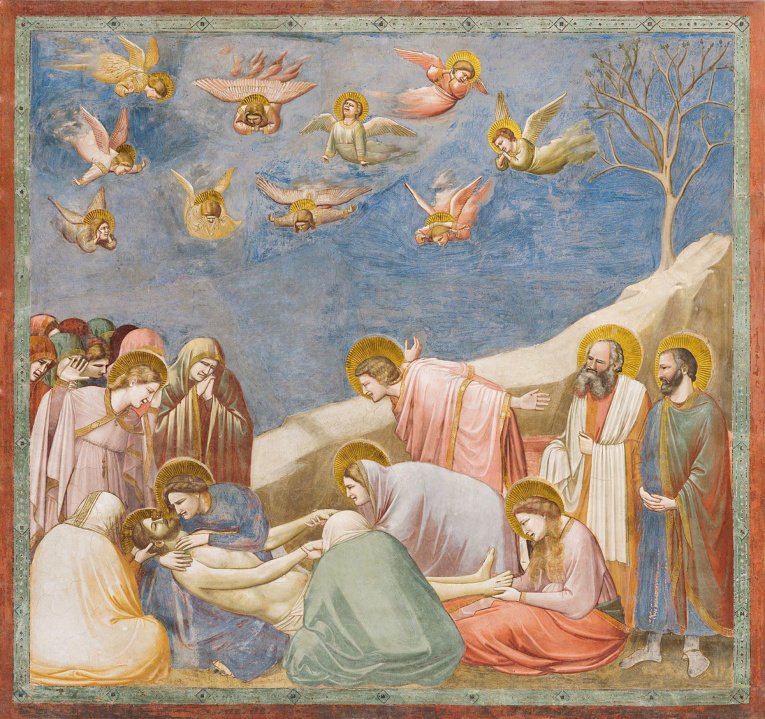
- Identify two of the figures in the fresco and their relationship to Christ.
i) _____________________________________________________________________
ii) _____________________________________________________________________
- Describe the way Giotto has depicted the human form.
5
Page 7
Form II Art History Supplementary Material
3. How are Giotto’s figures different from those in Byzantine mosaics?
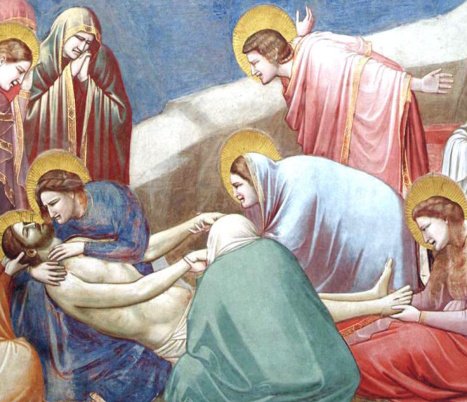
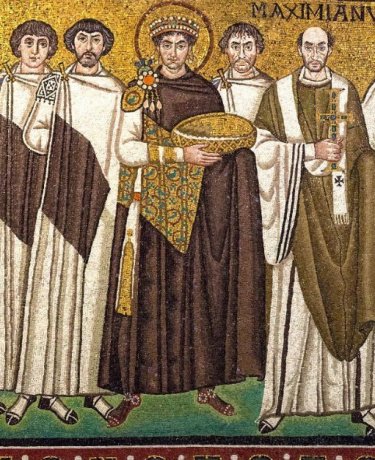
4. What evidence of symbolism is there in the Lamentation of the Death of Christ ?
5. How has Giotto created a sense of three-dimensional space?
6. What important compositional choices has Giotto made?
6
Page 8
Form II Art History Supplementary Material
Extension learning: define the following words
Renaissance
The Holy Roman Empire
Roman Catholic Church
Middle Ages
Nicolaus Copernicus
Medici Family
Giorgio Vasari
Enrico Scrovegni
7
Page 9
Form II Art History Supplementary Material
Extension reading
‘Now in the year 1276, in the country of Florence, about fourteen miles from the city, in the village of Vespignano, there was born to a simple peasant named Bondone a son, to whom he gave the name of Giotto, and whom he brought up according to his station. And when he had reached the age of ten years, showing in all his ways though still childish an extraordinary vivacity and quickness of mind, which made him beloved not only by his father but by all who knew him, Bondone gave him the care of some sheep. And he leading them for pasture, now to one spot and now to another, was constantly driven by his natural inclination to draw on the stones or the ground some object in nature, or something that came into his mind. One day Cimabue, going on business from Florence to Vespignano, found Giotto, while his sheep were feeding, drawing a sheep from nature upon a smooth and solid rock with a pointed stone, having never learnt from any one but nature. Cimabue, marvelling at him, stopped and asked him if he would go and be with him. And the boy answered that if his father were content he would gladly go. Then Cimabue asked Bondone for him, and he gave him up to him, and was content that he should take him to Florence. There in a little time, by the aid of nature and the teaching of Cimabue, the boy not only equalled his master, but freed himself from the rude manner of the Greeks, and brought back to life the true art of painting, introducing the drawing from nature of living persons, which had not been practised for two hundred years; or at least if some had tried it, they had not succeeded very happily. Giotto painted among others, as may be seen to this day in the chapel of the Podestà's Palace at Florence, Dante Alighieri, his contemporary and great friend, and no less famous a poet than Giotto was a painter’.
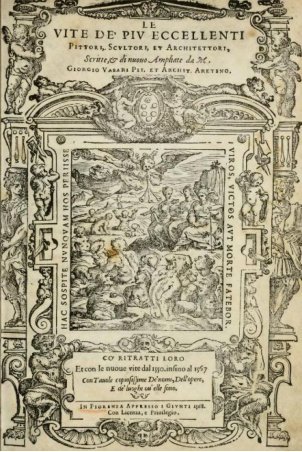
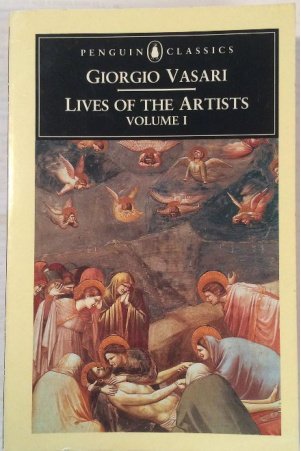
An excerpt from the original text by Vasari, first published in 1550. Its title is:
Lives of the Most Excellent Painters, Sculptors, and Architects
8
Page 10
Form II Art History Supplementary Material
NOTES
9
Page 11
Form II Art History Supplementary Material
10