Textbook p. 86
Page 1
Text below is OCR output and may contain recognition errors.
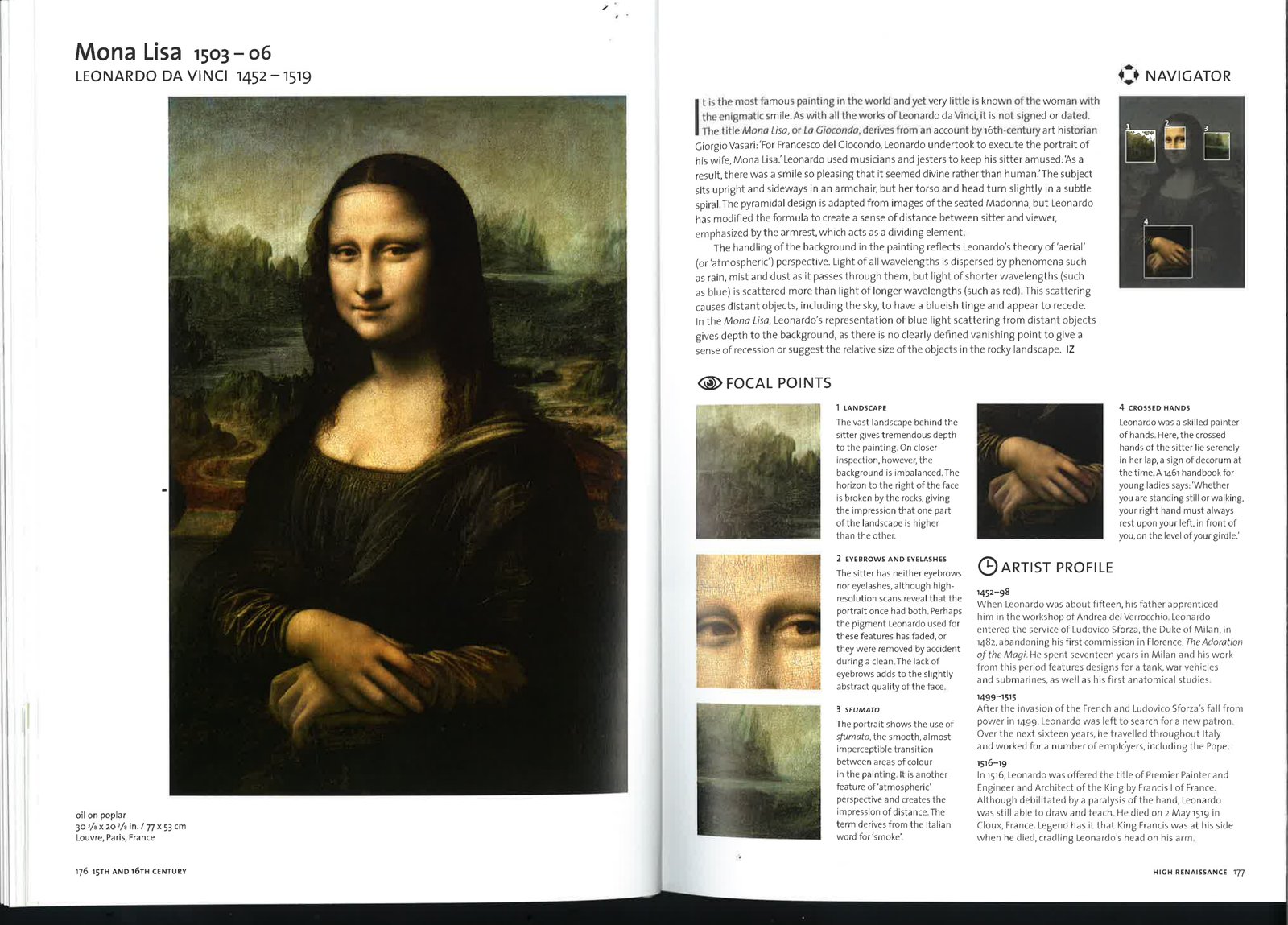
Mona Lisa 1503-06 LEONARDO DA VINCI 1452 — 1519
oil on poplar 30 3/4 x 20 1/s in. / 77X53. cm Louvre, Paris, France
176 15TH AND 16TH CENTURY
tis the most famous painting in the world and yet very little is known of the woman with
the enigmatic smile. As with all the works of Leonardo da Vinci, it is not signed or dated.
The title Mona Lisa, or La Gioconda, derives from an account by 16th-century art historian Giorgio Vasari: For Francesco del Giocondo, Leonardo undertook to execute the portrait of his wife, Mona Lisa.’ Leonardo used musicians and jesters to keep his sitter amused: As a result, there was a smile so pleasing that it seemed divine rather than human. The subject sits upright and sideways in an armchair, but her torso and head turn slightly in a subtle spiral, The pyramidal design is adapted from images of the seated Madonna, but Leonardo has modified the formula to create a sense of distance between sitter and viewer, emphasized by the armrest, which acts as a dividing element.
The handling of the background in the painting reflects Leonardo's theory of ‘aerial’
(or ‘atmospheric’) perspective. Light of all wavelengths is dispersed by phenomena such as rain, mist and dust as it passes through them, but light of shorter wavelengths (such as blue) is scattered more than light of longer wavelengths (such as red), This scattering
42> NAVIGATOR
causes distant objects, including the sky, to have a blueish tinge and appear to recede. In the Mona Lisa, Leonardo's representation of blue light scattering from distant objects gives depth to the background, as there is no clearly defined vanishing point to give a sense of recession or suggest the relative size of the objects in the rocky landscape. IZ
@® FOCAL POINTS
{| 1 LANDSCAPE
The vast landscape behind the sitter gives tremendous depth to the painting, On closer inspection, however, the background is imbalanced, The horizon to the right of the face is broken by the rocks, giving the impression that one part of the landscape is higher than the other.
| 2 EYEBROWS AND EYELASHES
The sitter has neither eyebrows nor eyelashes, although high- resolution scans reveal that the portrait once had both, Perhaps the pigment Leonardo used for these features has faded, or they were removed by accident during a clean, The lack of eyebrows adds to the slightly abstract quality of the face
3 SFUMATO
The portrait shows the use of sfumato, the smooth, almost imperceptible transition between areas of colour
in the painting. It is another feature of ‘atmospheric’ perspective and creates the impression of distance. The term derives from the Italian word for ‘smoke’
4 CROSSED HANDS
Leonardo was a skilled painter of hands, Here, the crossed hands of the sitter lie serenely in her lap,a sign of decorum at the time. A 1461 handbook for young ladies says:'Whether you are standing still or walking, your right hand must always rest upon your left, in front of you, on the level of your girdle.’
© ARTIST PROFILE
1452-98
When Leonardo was about fifteen, his father apprenticed
him in the workshop of Andrea del Verrocchio. Leonardo entered the service of Ludovico Sforza, the Duke of Milan, in 1482, abandoning his first commission in Florence, The Adoration of the Magi. He spent seventeen years in Milan and his work from this period features designs for a tank, war vehicles
and submarines, as well as his first anatomical studies 1499-1515
After the invasion of the French and Ludovico Sforza’s fall from power in 1499, Leonardo was left to search for a new patron Over the next sixteen years, he travelled throughout Italy
and worked for a number of employers, including the Pope, 1516-19
In 1516, Leonardo was offered the title of Premier Painter and Engineer and Architect of the King by Francis | of France. Although debilitated by a paralysis of the hand, Leonardo
was still able to draw and teach. He died on 2 May 1519 in Cloux, France, Legend has it that King Francis was at his side when he died, cradling Leonardo’s head on his arm
HIGH RENAISSANCE 177