Cycle 14: Early Netherlandish Art
Page 1
Form II Art History Supplementary Material
Cycle 13 – Early Netherlandish Art
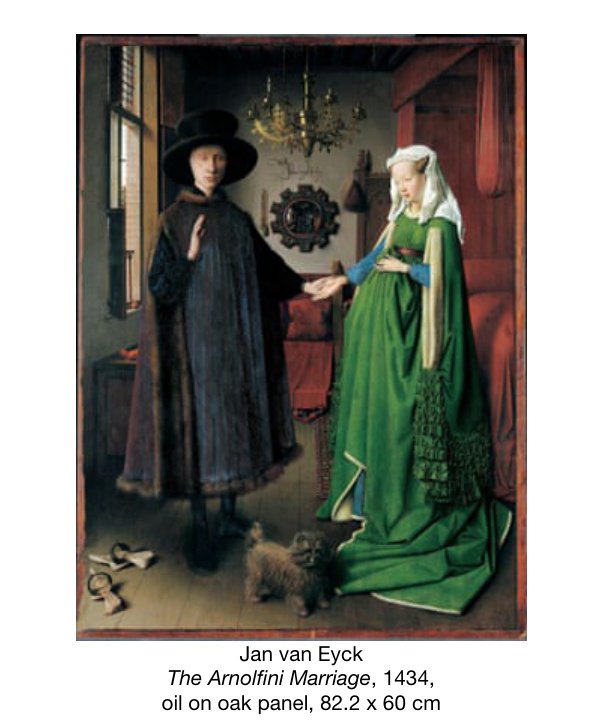
Jan van Eyck
The Arnolfini Marriage , 1434,
oil on oak panel, 82.2 x 60 cm
Name: ___________________________________________________
House / Tutor: ____________________________________________ Master: _____________________________________________________
Page 2
Form II Art History Supplementary Material
Key Points
-
Early Netherlandish (Flemish) art developed in the 15th -century Low Countries with a strong focus on realism over decorative Gothic styles
-
Artists used oil paint in layered glazes, allowing slow drying, blending, and fine detail
-
Works were painted on wood panels and aimed for a rich colour illusionistic effect
-
Subject matter shifted to domestic interiors, combining everyday life with a spiritual meaning – exploring material wealth and beauty.
-
Artist showed high skill in textures, light, and reflections (e.g. mirrors linking the viewer to the scene)
-
The movement grew from the wealth and trade networks of the Low Countries, supporting artists and guilds
*The Low Countries area coastal region located in Northwestern Europe.
*Decorative 15th-century Gothic style favoured lavish ornamentation over strict structural design.
Guilds dictated the 15th-century art world through several key functions: workplace rules, apprenticeship systems, major commissions, and social and religious duties.
Vocabulary:
-
Oil paint
-
Glazes
-
Illusionistic effect
-
Guilds
2
Page 3
Form II Art History Supplementary Material
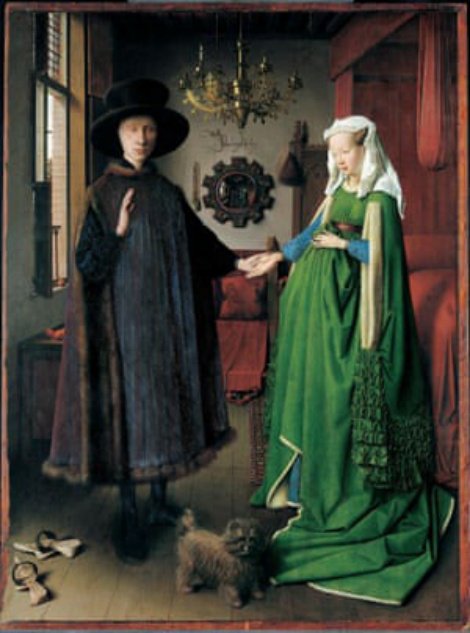
Jan van Eyck The Arnolfini Marriage , 1434, oil on oak panel, 82.2 x 60 cm
Oil paint is a slow-drying paint that consists of pigment suspended in a drying oil, commonly linseed oil. The viscosity (thickness) of the paint may be modified by the addition of a solvent such as turpentine, and varnish may be added later to increase the glossiness of the painting.
-
Artists have used oil paints since the 8th century, but their widespread use dates from the early 15th century.
-
Oil paints are incredibly slow drying, allowing the artist time to blend colours together and create intricate, illusionistic detail.
-
The first supports artists painted on were panels of wood.
-
Works were built up by painting layer upon layer of translucent applications of thin oil paint called glazes to achieve subtle changes in tone and rich colours.
The term ‘Early Netherlandish art’ refers to works produced in the Low Countries, roughly equivalent to modern-day Belgium and Luxembourg. This style, also referred to as ‘Flemish’, was created in the 15th century, where Netherlandish painters developed a profoundly different style and approach to their subject matter.
Conventions of Early Netherlandish Art
-
The artist rejected the elegance and extravagant decoration of the International Gothic age.
-
Artists favoured a new realism in their approach.
-
Scenes of high drama were replaced with domestic interiors where spirituality and reality were equal in subject matter.
-
Artists became more confident in portraying both the human figure and the natural world.
-
It was common for artists during this period to display their technical skills in a naturalistic style by including various fabrics as well as
Close-up of the reflective mirror in The Arnolfini Marriage.
using reflective mirrors to link the audience to the pictorial space.
3
Page 4
Form II Art History Supplementary Material
Key Artists of Early Netherlandish Art
-
Jan van Eyck (c. 1390-1441)
-
Rogier van der Weyden (c.1399-1464)
-
Hans Memling (c.1430/40-94)
-
Hugo van der Goes (c.1440-82)
The ‘world’ of the Low Countries during the 15th Century
-
The region’s economic prosperity was key to the success of early Netherlandish art.
-
• Trade, from the northern ports (including wool) helped the Netherlands become a bustling cosmopolitan market.
-
Many artists were attracted to the area from other regions due to the increase in commercial activities.
-
As the Flemish region prospered, artists benefited from the growing wealth and importance of Guilds (merchants who oversee the practice of their craft/trade in an area) and civic authorities.
Read Early Netherlandish Art (textbook p.140-143) and answer the following questions:
- Where were the ‘Low Countries’
- What characterised the artistic style of Flemish artists?
- Describe the way Flemish artists such as Jan van Eyck applied oil paint.
4
Page 5
Form II Art History Supplementary Material
Read The Arnolfini Marriage (textbook p. 144-145) and watch the Khan Academy video to answer the following questions.
Jan van Eyck, The Arnolfini Portrait (video) | Khan Academy
- What are two possible ways to interpret The Arnolfini Marriage ?
i_________________________________________________________________________ ii_________________________________________________________________________
- What is the significance of the convex mirror (refer to page 2) in the centre of the composition?
3. Name and describe five uses of symbolism in the painting:
i__________________________________________________________________________________ __________________________________________________________________________________ __________________________________________________________________________________
ii_________________________________________________________________________________ __________________________________________________________________________________ __________________________________________________________________________________ iii_________________________________________________________________________________ __________________________________________________________________________________ __________________________________________________________________________________ iv_________________________________________________________________________________ __________________________________________________________________________________ __________________________________________________________________________________ v_________________________________________________________________________________ __________________________________________________________________________________ __________________________________________________________________________________
5