Textbook pp. 120-121
Page 1
Text below is OCR output and may contain recognition errors.
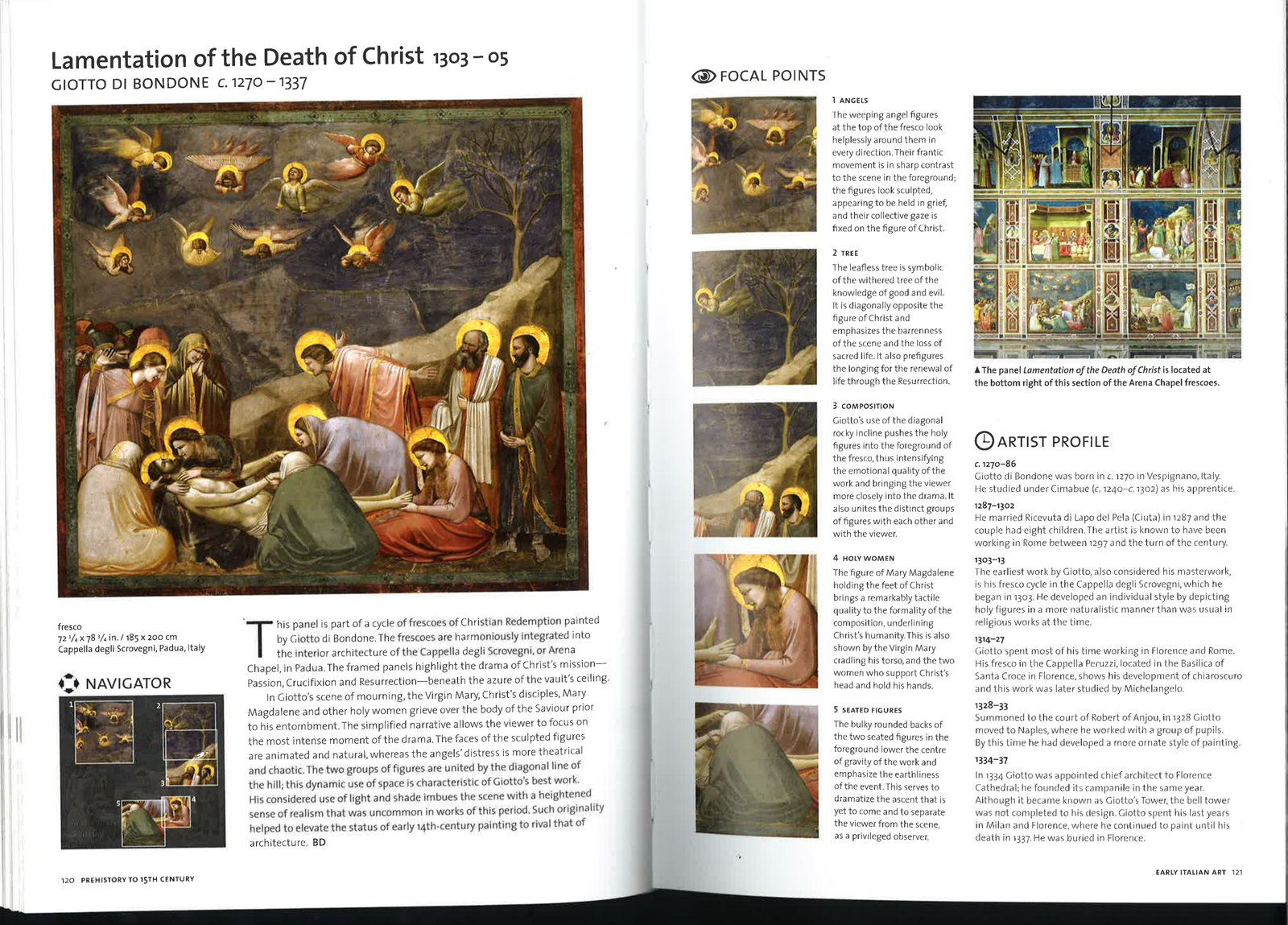
Lamentation of the Death of Christ 1303-05 GIOTTO DI BONDONE ©. 1270 - 1337
fresco 72 3/4 x 78 3/, in. / 185 x 200 cm Cappella degli Scrovegni, Padua, Italy
¢) NAVIGATOR
120 PREHISTORY TO 15TH CENTURY
his panel is part of a cycle of frescoes of Christian Redemption painted by Giotto di Bondone. The frescoes are harmoniously integrated into the interior architecture of the Cappella degli Scrovegni, or Arena Chapel, in Padua. The framed panels highlight the drama of Christ's mission— Passion, Crucifixion and Resurrection—beneath the azure of the vault’s ceiling. In Giotto’s scene of mourning, the Virgin Mary, Christ’s disciples, Mary Magdalene and other holy women grieve over the body of the Saviour prior to his entombment. The simplified narrative allows the viewer to focus on the most intense moment of the drama. The faces of the sculpted figures are animated and natural, whereas the angels’ distress is more theatrical and chaotic. The two groups of figures are united by the diagonal line of the hill; this dynamic use of space Is characteristic of Giotto’s best work. His considered use of light and shade imbues the scene with a heightened sense of realism that was uncommon in works of this period. Such originality helped to elevate the status of early 14th-century painting to rival that of architecture. BD
<> FOCAL POINTS
1 ANGELS
The weeping angel figures
at the top of the fresco look helplessly around them in every direction. Their frantic movement is in sharp contrast to the scene in the foreground; the figures look sculpted, appearing to be held in grief, and their collective gaze is fixed on the figure of Christ.
2 TREE
The leafless tree is symbolic of the withered tree of the knowledge of good and evil.
It is diagonally opposite the figure of Christ and emphasizes the barrenness
of the scene and the loss of sacred life. It also prefigures the longing for the renewal of life through the Resurrection.
3 COMPOSITION
Giotto's use of the diagonal rocky incline pushes the holy figures into the foreground of the fresco, thus intensifying the emotional quality of the work and bringing the viewer more closely into the drama, It also unites the distinct groups of figures with each other and with the viewer.
4 HOLY WOMEN
The figure of Mary Magdalene holding the feet of Christ brings a remarkably tactile quality to the formality of the composition, underlining Christ’s humanity. This is also shown by the Virgin Mary cradling his torso, and the two women who support Christ's head and hold his hands.
5 SEATED FIGURES
The bulky rounded backs of the two seated figures in the foreground lower the centre of gravity of the work and emphasize the earthliness of the event. This serves to dramatize the ascent that is yet to come and to separate the viewer from the scene, as a privileged observer,
A The panel Lamentation of the Death of Christ is located at the bottom right of this section of the Arena Chapel frescoes.
© ARTIST PROFILE
c. 1270-86 Giotto di Bondone was born in c. 1270 in Vespignana, Italy. He studied under Cimabue (c. 1240~c. 1302) as his apprentice.
1287-1302
He married Ricevuta di Lapo del Pela (Ciuta) in 1287 and the couple had eight children, The artist is known to have been working in Rome between 1297 and the turn of the century. 1303-13
The earliest work by Giotto, also considered his masterwork,
is his fresco cycle in the Cappella degli Scrovegni, which he began in 1303. He developed an individual style by depicting holy figures in a more naturalistic manner than was usual in religious works at the time.
1314-27
Giotto spent most of his time working in Florence and Rome. His fresco in the Cappella Peruzzi, located in the Basilica of Santa Croce in Florence, shows his development of chiaroscuro and this work was later studied by Michelangelo.
1328-33
Summoned to the court of Robert of Anjou, in 1328 Giotto moved to Naples, where he worked with a group of pupils.
By this time he had developed a more ornate style of painting.
1334-37
In 1334 Giotto was appointed chief architect to Florence Cathedral; he founded its campanile in the same year. Although it became known as Giotto’s Tower, the bell tower was not completed to his design. Giotto spent his last years in Milan and Florence, where he continued to paint until his death in 1337. He was buried in Florence.
EARLY ITALIAN ART 121