Textbook pp. 222-267: Dutch Golden Age and Rembrandt
Page 1
Text below is OCR output and may contain recognition errors.
DUTCH GOLDEN AGE
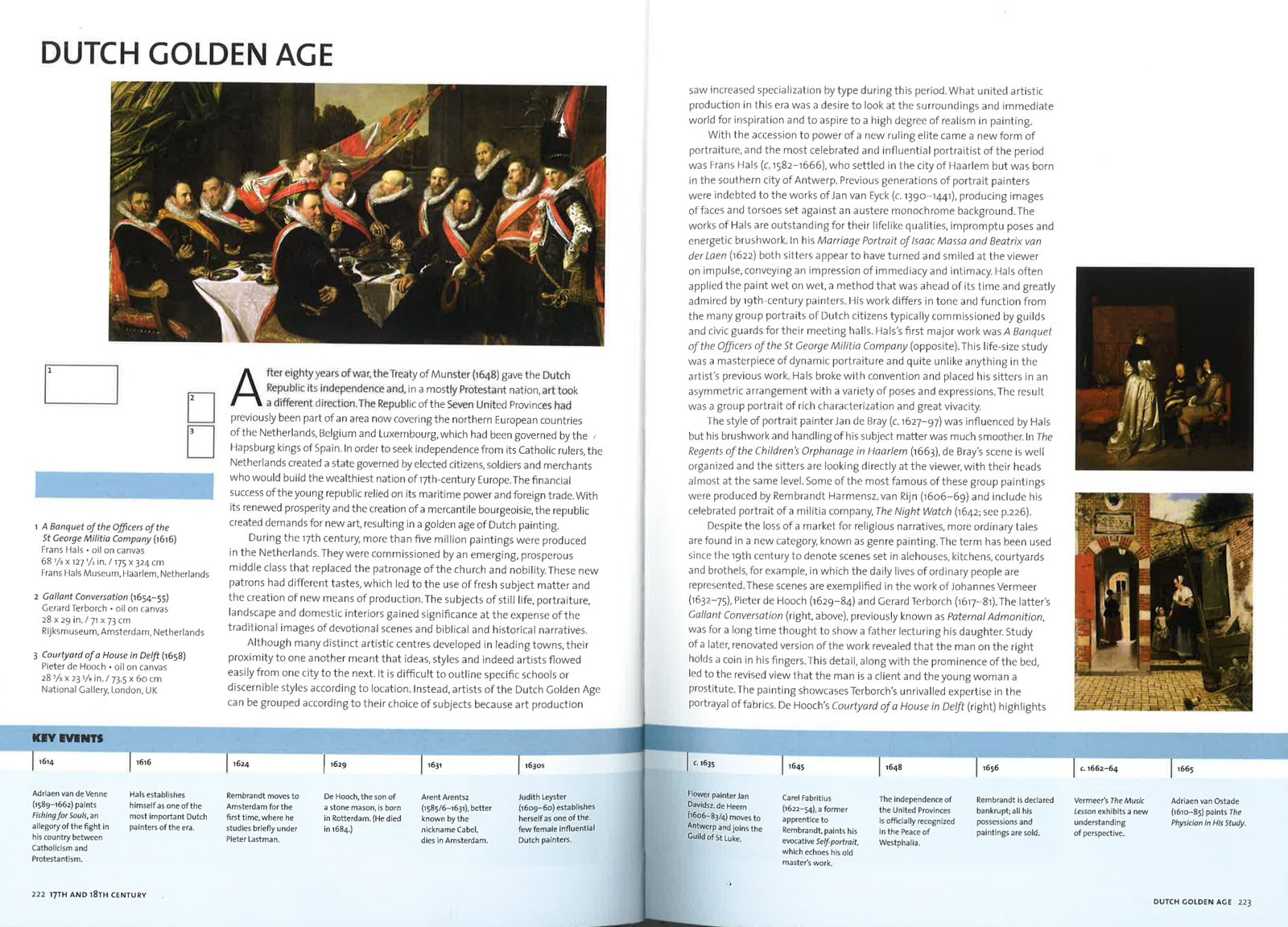
1 A Banquet of the Officers of the St George Militia Company (1616) Frans Hals + oil on canvas 68 7/e x 127 '/2 in. / 175 x 324. cM Frans Hals Museum, Haarlem, Netherlands
2 Gallant Conversation (1654-55) Gerard Terborch + oil on canvas 28 x 29 in./ 71x 73cm Rijksmuseum, Amsterdam, Netherlands
3 Courtyard of a House in Delft (1658) Pieter de Hooch « oil on canvas 28 7/s x 23 5/ain./ 73,5 x 60 cm National Gallery, London, UK
Republic its independence and, in a mostly Protestant nation, art took a different direction, The Republic of the Seven United Provinces had
previously been part of an area now covering the northern European countries of the Netherlands, Belgium and Luxembourg, which had been governed by the » Hapsburg kings of Spain. In order to seek independence from its Catholic rulers, the Netherlands created a state governed by elected citizens, soldiers and merchants who would build the wealthiest nation of 17th-century Europe. The financial success of the young republic relied on its maritime power and foreign trade. With its renewed prosperity and the creation of a mercantile bourgeoisie, the republic created demands for new art, resulting in a golden age of Dutch painting.
During the 17th century, more than five million paintings were produced in the Netherlands. They were commissioned by an emerging, prosperous middle class that replaced the patronage of the church and nobility. These new patrons had different tastes, which led to the use of fresh subject matter and the creation of new means of production. The subjects of still life, portraiture, landscape and domestic interiors gained significance at the expense of the traditional images of devotional scenes and biblical and historical narratives.
Although many distinct artistic centres developed in leading towns, their proximity to one another meant that ideas, styles and indeed artists flowed easily from one city to the next. It is difficult to outline specific schools or discernible styles according to location. Instead, artists of the Dutch Golden Age can be grouped according to their choice of subjects because art production
A fter eighty years of war, the Treaty of Munster (1648) gave the Dutch
1629
saw increased specialization by type during this period. What united artistic production in this era was a desire to look at the surroundings and immediate world for inspiration and to aspire to a high degree of realism in painting.
With the accession to power of a new ruling elite came a new form of portraiture, and the most celebrated and influential portraitist of the period was Frans Hals (c, 1582-1666), who settled in the city of Haarlem but was born in the southern city of Antwerp, Previous generations of portrait painters were indebted to the works of Jan van Eyck (c. 1390-1441), producing images of faces and torsoes set against an austere monochrome background. The works of Hals are outstanding for their lifelike qualities, impromptu poses and energetic brushwork. In his Marriage Portrait of Isaac Massa and Beatrix van der Laen (1622) both sitters appear to have turned and smiled at the viewer on impulse, conveying an impression of immediacy and intimacy. Hals often applied the paint wet on wet, a method that was ahead of its time and greatly admired by 19th-century painters, His work differs in tone and function from the many group portraits of Dutch citizens typically commissioned by guilds and civic guards for their meeting halls. Hals’s first major work was A Banquet of the Officers of the St George Militia Company (opposite). This life-size study was a masterpiece of dynamic portraiture and quite unlike anything in the artist's previous work, Hals broke with convention and placed his sitters in an asymmetric arrangement with a variety of poses and expressions. The result was a group portrait of rich characterization and great vivacity.
The style of portrait painter Jan de Bray (c. 1627-97) was influenced by Hals but his brushwork and handling of his subject matter was much smoother. In The Regents of the Children’s Orphanage in Haarlem (1663), de Bray's scene is well organized and the sitters are looking directly at the viewer, with their heads almost at the same level. Some of the most famous of these group paintings were produced by Rembrandt Harmensz. van Rijn (1606-69) and include his celebrated portrait of a militia company, The Night Watch (1642; see p.226).
Despite the loss of a market for religious narratives, more ordinary tales are found in a new category, known as genre painting. The term has been used since the 19th century to denote scenes set in alehouses, kitchens, courtyards and brothels, for example, in which the daily lives of ordinary people are represented, These scenes are exemplified in the work of Johannes Vermeer (1632-75), Pieter de Hooch (1629-84) and Gerard Terborch (1617~81). The latter’s Gallant Conversation (right, above), previously known as Paternal Admonition, was for a long time thought to show a father lecturing his daughter. Study of a later, renovated version of the work revealed that the man on the tight holds a coin in his fingers. This detail, along with the prominence of the bed, led to the revised view that the man is a client and the young woman a prostitute, The painting showcases Terborch’s unrivalled expertise in the portrayal of fabrics. De Hooch’s Courtyard of a House in Delft (right) highlights
Adriaen van de Venne (1589-1662) paints Fishing for Souts, an allegory of the fight in his country between Catholicism and Protestantism.
Hals establishes Rembrandt moves to himself as one of the Amsterdam for the most important Dutch first time, where he painters of the era.
Flower painter Jan Davidsz. de Heem (1606-83/4) moves to Antwerp and joins the Guild of St Luke,
De Hooch, the son of a stone mason, is born in Rotterdam, (He died studies briefly under in 1684.)
Pieter Lastman.
Arent Arentsz (1585/6-1631), better known by the nickname Cabel, dies in Amsterdam.
Judith Leyster (1609-60) establishes herself as one of the few female influential Dutch painters.
Carel Fabritius (1622-54), a former
The independence of the United Provinces apprentice to is officially recognized Rembrandt, paints his in the Peace of evocative Self-portrait, Westphalia.
which echoes his old
master's work,
Vermeer's The Music Lesson exhibits a new understanding
of perspective,
Rembrandt is declared bankrupt; all his possessions and paintings are sold.
Adriaen van Ostade (1610-85) paints The Physician in His Study.
222 17TH AND 18TH CENTURY DUTCH GOLDEN AGE 223
Page 2
Text below is OCR output and may contain recognition errors.
his careful observation of architecture. De Hooch often depicted courtyard settings, as they allowed him to explore the effects of perspective; the scene from the courtyard in Delft cleverly provides a view through the passageway and into the street beyond, Like Vermeer, de Hooch delighted in minute detail, seen in the contrasting patterns of colour and texture in the different brickwork. The human figures in de Hooch’s works, however, are less compelling than those portrayed in Vermeer’s domestic scenes, such as The Kitchen Maid (c. 1658; see p.228).
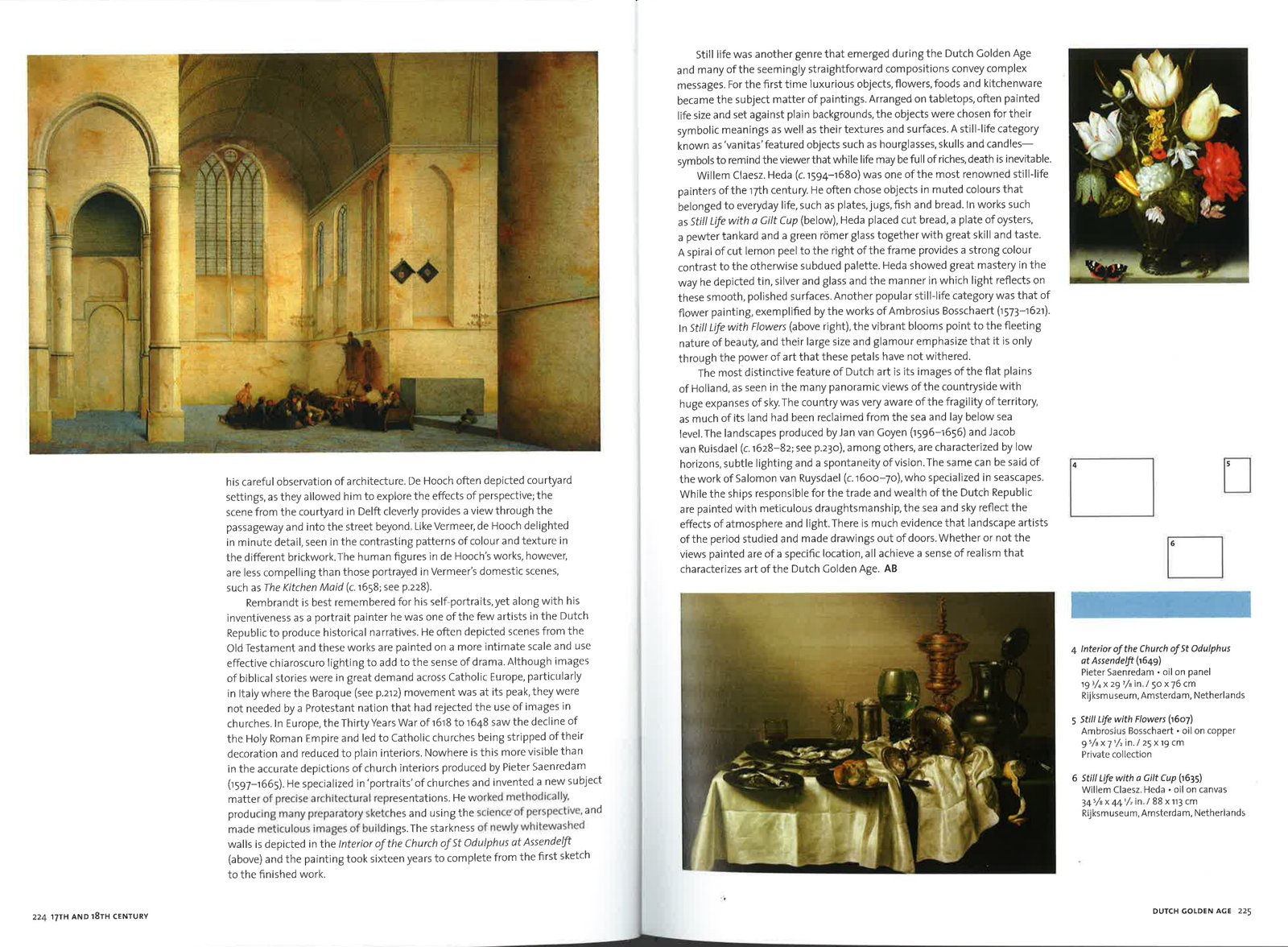
Rembrandt is best remembered for his self-portraits, yet along with his inventiveness as a portrait painter he was one of the few artists in the Dutch Republic to produce historical narratives. He often depicted scenes from the Old Testament and these works are painted on a more intimate scale and use effective chiaroscuro lighting to add to the sense of drama. Although images of biblical stories were in great demand across Catholic Europe, particularly in Italy where the Baroque (see p.212) movement was at its peak, they were not needed by a Protestant nation that had rejected the use of images in churches. In Europe, the Thirty Years War of 1618 to 1648 saw the decline of the Holy Roman Empire and led to Catholic churches being stripped of their decoration and reduced to plain interiors. Nowhere is this more visible than in the accurate depictions of church interiors produced by Pieter Saenredam (1597-1665). He specialized in ‘portraits’ of churches and invented a new subject matter of precise architectural representations. He worked methodically, producing many preparatory sketches and using the science’ of perspective, and made meticulous images of buildings. The starkness of newly whitewashed walls is depicted in the Interior of the Church of St Odulphus at Assendelft (above) and the painting took sixteen years to complete from the first sketch to the finished work.
224 17TH AND 18TH CENTURY
Still life was another genre that emerged during the Dutch Golden Age and many of the seemingly straightforward compositions convey complex messages. For the first time luxurious objects, flowers, foods and kitchenware became the subject matter of paintings. Arranged on tabletops, often painted life size and set against plain backgrounds, the objects were chosen for their symbolic meanings as well as their textures and surfaces. A still-life category known as ‘vanitas’ featured objects such as hourglasses, skulls and candles—
symbols to remind the viewer that while life may be full of riches, death is inevitable.
Willem Claesz. Heda (c. 1594-1680) was one of the most renowned still-life painters of the a7th century. He often chose objects in muted colours that belonged to everyday life, such as plates, jugs, fish and bread. In works such as Still Life with a Gilt Cup (below), Heda placed cut bread, a plate of oysters,
a pewter tankard and a green rémer glass together with great skill and taste. A spiral of cut lemon peel to the right of the frame provides a strong colour contrast to the otherwise subdued palette. Heda showed great mastery in the way he depicted tin, silver and glass and the manner in which light reflects on these smooth, polished surfaces. Another popular still-life category was that of flower painting, exemplified by the works of Ambrosius Bosschaert (1573-1621). In Still Life with Flowers (above right), the vibrant blooms point to the fleeting nature of beauty, and their large size and glamour emphasize that it is only through the power of art that these petals have not withered.
The most distinctive feature of Dutch art is its images of the flat plains of Holland, as seen in the many panoramic views of the countryside with huge expanses of sky. The country was very aware of the fragility of territory, as much of its land had been reclaimed from the sea and lay below sea level. The landscapes produced by Jan van Goyen (1596-1656) and Jacob van Ruisdael (c. 1628-82; see p.230), among others, are characterized by low horizons, subtle lighting and a spontaneity of vision. The same can be said of the work of Salomon van Ruysdael (c. 1600-70), who specialized in seascapes. While the ships responsible for the trade and wealth of the Dutch Republic are painted with meticulous draughtsmanship, the sea and sky reflect the effects of atmosphere and light. There is much evidence that landscape artists of the period studied and made drawings out of doors. Whether or not the views painted are of a specific location, all achieve a sense of realism that characterizes art of the Dutch Golden Age. AB
4 Interior of the Church of St Odulphus at Assendelft (1649) Pieter Saenredam : oil on panel 193/4x 29 7/in./50x 76cm Rijksmuseum, Amsterdam, Netherlands
5 Still Life with Flowers (1607) Ambrosius Bosschaert + oil on copper 95/Ax7Ain./ 25x19. cM Private collection
6 Still Life with a Gilt Cup (1635) Willem Claesz, Heda « oil on canvas 345/ex 441/72 in. / 88 x13. cm Rijksmuseum, Amsterdam, Netherlands
DUTCH GOLDEN AGE 225
ne
Page 3
Text below is OCR output and may contain recognition errors.
The Night Watch 1642
REMBRANDT HARMENSZ. VAN RIJN 1606-69
oil on canvas
149 V2 178 ain. / 379.5 X 453.5 cm Rijksmuseum, Amsterdam, Netherlands
(<> NAVIGATOR
226 17TH AND 18TH CENTURY
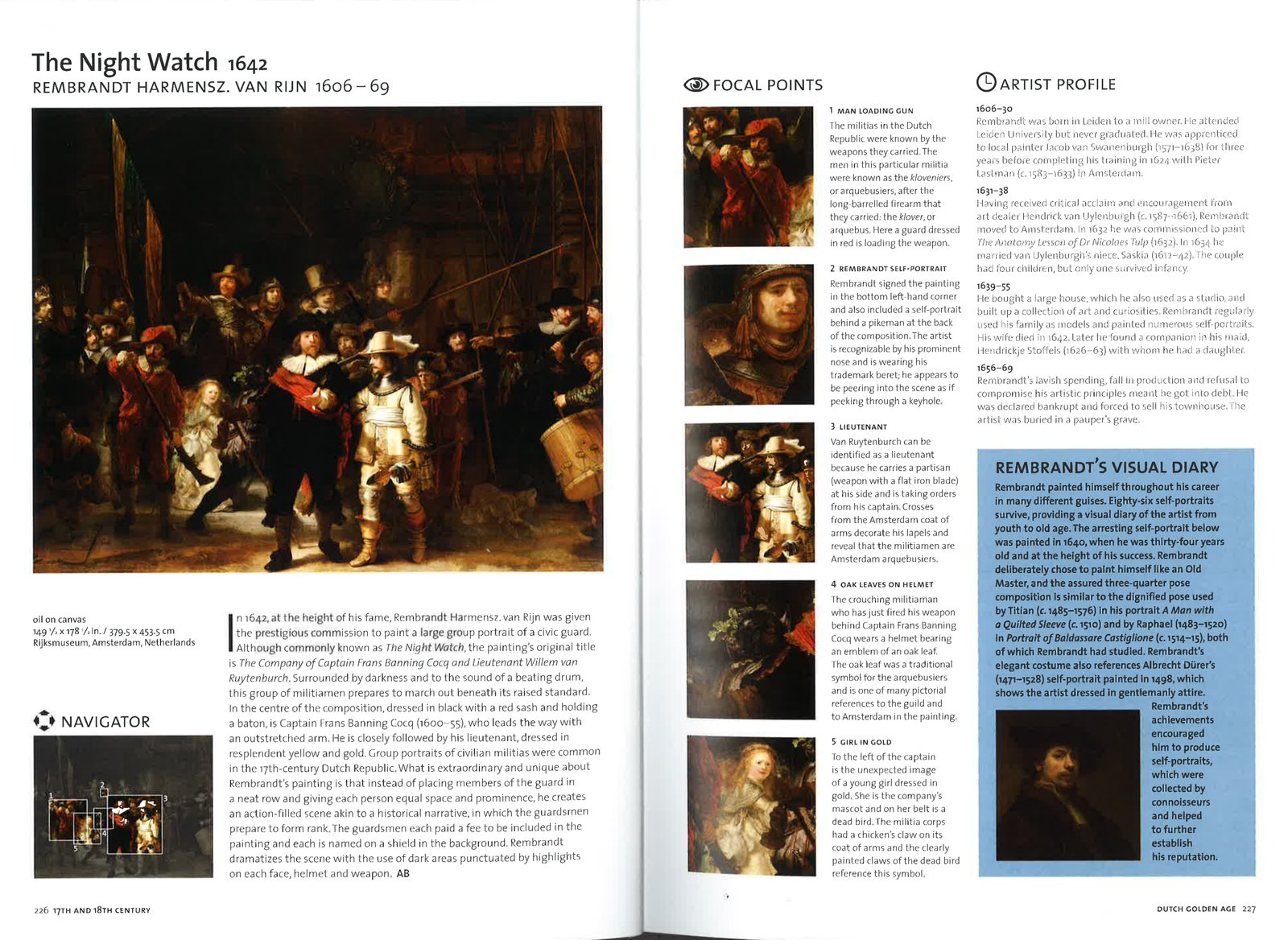
n 1642, at the height of his fame, Rembrandt Harmensz. van Rijn was given the prestigious commission to paint a large group portrait of a civic guard. Although commonly known as The Night Watch, the painting's original title is The Company of Captain Frans Banning Cocg and Lieutenant Willem van Ruytenburch, Surrounded by darkness and to the sound of a beating drum, this group of militiamen prepares to march out beneath its raised standard. In the centre of the composition, dressed in black with a red sash and holding a baton, is Captain Frans Banning Cocq (1600-55), who leads the way with an outstretched arm. He is closely followed by his lieutenant, dressed in resplendent yellow and gold. Group portraits of civilian militias were common in the 17th-century Dutch Republic. What is extraordinary and unique about Rembrandt's painting is that instead of placing members of the guard in a neat row and giving each person equal space and prominence, he creates an action-filled scene akin to a historical narrative, in which the guardsmen prepare to form rank. The guardsmen each paid a fee to be included in the painting and each is named on a shield in the background. Rembrandt dramatizes the scene with the use of dark areas punctuated by highlights on each face, helmet and weapon. AB
FOCAL POINTS
1 MAN LOADING GUN
The militias in the Dutch Republic were known by the weapons they carried. The
men in this particular militia were known as the k/oveniers, or arquebusiers, after the long-barrelled firearm that they carried: the klover, or arquebus, Here a guard dressed in red is loading the weapon
2 REMBRANDT SELF-PORTRAIT
Rembrandt signed the painting in the bottom left-hand corner and also included a self-portrait behind a pikeman at the back of the composition. The artist
is recognizable by his prominent nose and is wearing his trademark beret; he appears to be peering into the scene as if peeking through a keyhole.
3 LIEUTENANT
Van Ruytenburch can be identified as a lieutenant because he carries a partisan (weapon with a flat iron blade) at his side and is taking orders from his captain, Crosses
from the Amsterdam coat of arms decorate his lapels and reveal that the militiamen are Amsterdam arquebusiers
4 OAK LEAVES ON HELMET
The crouching militiaman who has just fired his weapon behind Captain Frans Banning Cocq wears a helmet bearing an emblem of an oak leaf.
The oak leaf was a traditional symbol for the arquebusiers and is one of many pictorial references to the guild and
to Amsterdam in the painting
5 GIRLIN GOLD
To the left of the captain
is the unexpected image
of a young girl dressed in
gold, She is the company’s mascot and on her belt is a dead bird. The militia corps had a chicken’s claw on its coat of arms and the clearly painted claws of the dead bird reference this symbol
© ARTIST PROFILE
1606-30
Rembrandt was bern in Leiden to a mill owner. He attended Leiden University but never graduated. He was apprenticed to local painter Jacob van Swanenburgh (571-1638) for three yeais before completing his training in 1624 wilh Pieter Lasiman (¢.1583~1633) In Amsterdam
1631-38
Having received critical acclaim and encouragement From
art dealer Hendrick van Uylenburgh (c. 1587-1661), Rembrandt moved to Amsterdam. In 1632 he was commissioned to paint The Anatomy Lesson of Or Nicolaes Tulp 632), 1n 1634 hie married van Uylenburgh’s niece, Saskia ~42). The couple had four children, but only one survived infancy,
1639-55
He bought a large house, which he also used as a studio, and built up a collection of att and curlosities, Rembrandt regularly used his family as models and painted numerous self-portraits His wife died in 1642. Later he found a cornpanion in his maid, Hendrickje Stoffels (1626-63) with whom he had a daughter 1656-69
Rembrandt’s lavish spending, fall ini production and refusal to compromise his artistic principles rneant he got into debt. He was declared bankrupt atid forced to sell his townhouse. The
artist was buried ina pauper’s grave
REMBRANDT'S VISUAL DIARY
Rembrandt painted himself throughout his career in many different guises. Eighty-six self-portraits survive, providing a visual diary of the artist from youth to old age. The arresting self-portrait below was painted in 1640, when he was thirty-four years old and at the height of his success. Rembrandt deliberately chose to paint himself like an Old Master, and the assured three-quarter pose composition Is similar to the dignified pose used by Titian (c. 1485-1576) in his portrait A Man with
a Quilted Sleeve (c. 1510) and by Raphael (1483-1520) in Portrait of Baldassare Castiglione (c. 1514-15), both of which Rembrandt had studied. Rembrandt's elegant costume also references Albrecht Diirer’s (1471-1528) self-portrait painted in 1498, which shows the artist dressed in gentlemanly attire. Rembrandt's achievements encouraged
him to produce self-portraits, which were collected by connoisseurs and helped
to further establish
his reputation.
DUTCH GOLDEN AGE 227